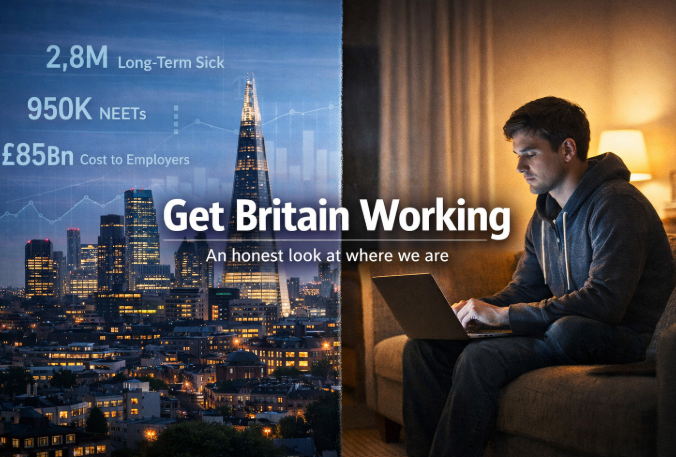
Britain has an employment problem, but it’s not the one that makes headlines. Unemployment is relatively low. The issue is the millions of people who’ve stopped looking for work altogether.
Since 2019, 800,000 more working-age people have dropped out of the workforce due to health problems. Long-term sickness now keeps 2.8 million people at home. Nearly a million young people aren’t in education, employment or training. Add it up and more than one in five working-age adults are out of work and not looking.
This costs everyone. The person who leaves work at 22 due to ill health could end up over £1 million worse off across their lifetime. Employers lose £85 billion a year through sickness absence and turnover. The state spends £212 billion annually on the consequences. Without change, another 600,000 people could fall out of work by 2030.
The government’s response came in late 2024 with two linked initiatives.
Get Britain Working is the policy programme: reforming jobcentres, guaranteeing support for young people, testing new approaches in local areas. Keep Britain Working, led by former John Lewis chair Sir Charlie Mayfield, focuses on what employers need to do differently.
We’re now over a year in. Programmes are running, money is flowing and reports have been published and responded to. So, let’s take a look at where things actually stand, what’s progressed, what’s stalled and what still isn’t working.
The initiatives break down into several key programmes, each targeting different parts of the problem. Here’s how they’re performing so far.
Connect to Work: Live, But Patchy
Connect to Work is the new programme for helping people with disabilities and those with health conditions into employment. It launched in mid-2025 and is now running in dozens of areas, backed by £338 million to support over 85,000 people.
The model makes sense. It’s called “place, train, maintain” — help someone find the right job, train them in what they need, then keep supporting them so they don’t fall out. The evidence on supported employment is solid when it’s done properly.
The problem is rollout. Some areas were ready last summer, others are still mobilising six months later. “Phased rollout shaped by local authorities’ own timetables” sounds like flexibility. In reality it means someone in Gloucestershire has been getting support since July while someone in a neighbouring area is still waiting.
And there’s a recruitment crunch. The programme needs Employment Specialist Coaches with genuine expertise in supported employment. Those people aren’t easy to find. Several areas are struggling to build teams fast enough to hit their targets.
The architecture is there. Whether it delivers is another question.
Youth Guarantee: Extended, But Where’s the Evidence?
The Youth Guarantee is the government’s promise that every young person aged 18-21 will have access to a job, an apprenticeship, or training. Rather than roll it out nationally straight away, the government set up eight “trailblazer” areas to test what works: Liverpool, West Midlands, Tees Valley, East Midlands, West of England, Cambridgeshire and Peterborough, and two in London.
These have been running since spring 2025 and last August, the government extended funding by another £45 million, taking the programme through to March 2027. That’s either confidence in the approach or acknowledgment that one year wasn’t enough to prove anything.
Different areas are trying different things, including giving free bus passes and mental health support and focusing on young people who grew up in care.
However, we’re nearly two years in and we can’t tell which approaches work. The point of trailblazers is to figure out what works before going national. If the learning isn’t being shared, what’s the point?
Meanwhile the numbers haven’t shifted. The latest data shows 948,000 young people still not in education, employment or training. That’s roughly where we started.
The Jobcentre Overhaul is Years Away
One of the headline announcements in the original white paper was merging Jobcentre Plus with the National Careers Service to create a proper “jobs and careers service.” The vision was compelling: transform jobcentres from places that police benefit claims into places that actually help people build careers. Use AI to personalise support. Create a “Jobcentre in your pocket.”
The reality is slower. According to what the Department for Work and Pensions told Parliament, the actual timeline is:
- 2025-26: run trials in a few places
- 2026-27: roll out what works, start integrating the two services
- 2027-28: launch the digital offering
So we’re looking at 2028 before anything like the original vision exists at scale. Right now there’s a small pathfinder in Wakefield and some prototype work happening.
The Work and Pensions Select Committee has criticised the lack of detail. Unions are worried about jobs and the £55 million allocated for development doesn’t have a clear spending plan. It’ll happen eventually, but anyone expecting transformation soon will be waiting.
The Employer Agenda is Progressing
The Keep Britain Working strand has moved faster than expected.
Sir Charlie Mayfield’s review made a compelling case. The system for managing sickness at work is broken. The “fit note” that doctors give people is supposed to explore what adjustments might help someone stay in work, but 93% just say “not fit” and leave it there. There’s a culture of fear where employees won’t disclose health problems because they’re worried about the consequences, and employers don’t ask because they don’t know what to do with the answer. People fall out of work who didn’t need to.
The review proposed a “Healthy Working Lifecycle” standard that employers could get certified against, a network of providers to help with case management, and a central unit to gather evidence on what actually works.
The government accepted the findings. Over 60 major employers signed up as “Vanguards” to test the new approaches with Tesco, John Lewis, and Aviva among them. Mayfield is co-chairing a taskforce with ministers. The Workplace Health Intelligence Unit is being set up.
This is real momentum. The question is whether it reaches beyond big companies with HR departments and dedicated budgets. But compared to other parts of the agenda, the employer-led work is probably furthest along.
The Controversy Nobody Wants to Discuss
Then there’s Pathways to Work.
In March 2025, the government published a Green Paper proposing significant changes to disability benefits. The details are technical but the direction is clear: make it harder to qualify for certain payments, and reduce the amounts for others.
The response was fierce. Nearly 48,000 people submitted consultation responses. Disability Rights UK, Scope, Trussell, and pretty much every organisation working with disabled people opposed major parts. The Work and Pensions Select Committee called for delays. There was a petition to scrap the whole thing.
The government made some changes to protect certain groups but hasn’t shifted the basic direction.
Get Britain Working and Connect to Work are supposed to help disabled people into employment by removing barriers and providing support. Pathways to Work is simultaneously cutting the income that disabled people rely on while they’re looking for work.
These two things pull in opposite directions. Financial stress doesn’t make job searching easier. Someone worried about rent because their benefits got cut isn’t in a great headspace to engage with employment support.
If you work in this space, you’re thinking about this. Pretending the conflict doesn’t exist doesn’t help anyone.
What Still Hasn’t Been Solved
Step back from the individual programmes and some fundamental problems remain.
There aren’t enough people to deliver any of this. Connect to Work needs specialist coaches. Youth Guarantee needs skilled youth workers. The transformed jobcentres need work coaches who can do career guidance, not just benefit compliance. These people don’t exist in sufficient numbers and nothing in the policy creates more of them.
The people who most need help aren’t engaging. Every programme assumes some baseline willingness to turn up. But the hardest groups don’t turn up. Young people with anxiety who can’t face appointments. People who’ve been out of work so long they’ve given up. People who don’t trust services because of past bad experiences. Making support available isn’t the same as making it accessible.
Everyone talks about early intervention but nothing is designed for it. The Keep Britain Working review made the point clearly: people off work for more than a year are five times less likely to return. Catch someone in the first weeks of a health problem and you’ve got a decent chance of keeping them in work. Wait until they’ve been home for a year and you’ve probably lost them.
But most provision is still set up for people who are already long-term inactive. Reaching people early means integration with employers and health services that doesn’t exist yet at any scale.
Where Does Technology Fit?
The white paper talks about AI and digital services as part of the future.
The useful question is: what can technology do that humans can’t, or can’t do at scale?
Availability is one thing. Traditional services have office hours. But someone lying awake at 3am worrying about their future needs help then, not in three weeks when an appointment opens up.
Capacity is another. There will never be enough advisers to give everyone intensive one-to-one support. If technology handles groundwork — initial conversations, skills exploration, goal setting — human time can go to the people who need it most.
Reach matters too. Some people will never walk into a jobcentre or youth hub. It’s not that they don’t want help. The format doesn’t work for them. Anxiety. Past bad experiences. Not seeing themselves as the “type” who goes to those places. Meeting them on their phone, on their terms, can get to people that traditional services miss.
At Saffron we’ve been working on this for a while. Our Create Your Own Future (CYOF) platform is designed around these specific problems.
CYOF really is a “Jobcentre in your pocket” – but better.
It uses AI in multiple ways – to enable conversation with a digital coach, to analyse transferable skills and match them to job profiles in the National Careers Service framework, match to live job boards and career mapping and also to accredited training. It generates a personalised action plan to help each milestone be broken down into manageable steps using a coaching model.
It reduces the time work coaches have to spend on the mundane aspects of their role and enables them to use the data from the user’s to assess confidence, feelings of control and commitment as well as see user activity. It enables them to use their skills to do what they do best – motivate, encourage and guide.
In the meanwhile, nudges and reminders from the platform as well as 24/7 help keep momentum going.
It’s already being deployed in the Cambridgeshire and Peterborough Youth Guarantee trailblazer now. Peterborough United Foundation opened their Youth Employment Hub in November and CYOF is part of how they’re reaching young people who might not engage with traditional services. It addresses specific gaps that the current system struggles with.
What Happens Next?
The next year will show whether Get Britain Working and Keep Britain Working deliver more than previous initiatives.
Connect to Work needs to demonstrate actual outcomes, not just participant numbers. Youth Guarantee needs published evidence on what’s working before anyone talks about national rollout. The jobcentre merger needs to speed up and get clearer. The Vanguard employers need to show that workplace health approaches work beyond big corporates.
For those of us delivering services, the job is building things that work within the system we’ve got, while being honest about what it still can’t do.
If you’re involved in Youth Guarantee delivery, Connect to Work, or writing a Local Get Britain Working Plan, and you’re wrestling with any of this, we’d be happy to talk.
If you’re curious whether CYOF could work for your area, we’re happy to walk you through it.
Get in touch with us to see how it works.