

Confidence Is the Barrier Nobody Funds
Confidence Is the Barrier Nobody Funds
Ask what stops someone getting back to work and you’ll hear about skills, qualifications, experience. You’ll rarely hear the honest answer, which is that a lot of people simply don’t believe they could do the job they’re perfectly capable of doing.
Confidence sounds like a soft factor right up until you notice it predicts almost everything that matters. Whether someone applies, shows up and keeps going when the first knockback lands. Build the belief and the behaviour tends to follow. Skip it, and the best-resourced programme still stalls.
Fund What You Can Measure, Skip What You Can’t
Funding models are built around what’s easy to specify and easy to check. A qualification has a certificate. A CV workshop has an attendance sheet. Confidence has neither, so it rarely makes it into a contract, a KPI, or a line in a delivery plan.
That’s mostly because confidence is hard to define precisely, harder to measure consistently, and almost impossible to attribute cleanly to a single intervention. Skills training has a clear before and after. Confidence has neither a clean starting point nor an obvious way to prove the gain was real.
So it gets treated as a by-product. Something that hopefully improves alongside the training, the CV workshop, the interview practice, rather than something the programme is actually designed to build.
Watch for the Moments Confidence Actually Breaks
The gap shows up in specific, recognisable moments.
Someone who’s technically qualified for a role doesn’t apply, because in their head the job is for a different kind of person. Someone shows up to an interview and undersells everything they’ve done, not because they lack the achievements but because they’ve stopped believing the achievements count. Someone gets a knockback in week two of a job search and the search quietly stops, not because the market shifted but because the knockback confirmed something they already suspected about themselves.
None of these show up as a skills gap. All of them look, from the outside, like motivation problems, or worse, like someone who isn’t trying hard enough. That reading is usually wrong. Behavioural science has a fairly consistent finding here. Self-efficacy, the belief that you’re capable of succeeding at a specific task, is one of the strongest predictors of whether someone attempts the task at all, and whether they persist through setbacks once they’ve started. It’s not a nice-to-have sitting alongside the real work. For a lot of participants, it’s the precondition for everything else working, which is also why intervening early, before disengagement sets in, tends to cost less and achieve more than trying to rebuild belief after it’s gone.
Build Confidence on Purpose, Then Measure It
If confidence behaves like a hard outcome, the honest response is to treat it like one. Build it on purpose. Measure it honestly. Hold it to the same standard as any other outcome a programme is judged on.
That’s a different design brief to “run a CV workshop and hope people leave feeling better.” It means creating small, winnable moments early, so someone has direct evidence they can do the thing before being asked to do the harder version of it. It means separating the skill from the self-worth, so a knockback reads as information about one application rather than a verdict on the person. It means giving people a way to see their own progress, because confidence tends to build on evidence, not encouragement alone.
It also means being willing to track it. Not perfectly, and not with false precision, but consistently enough to know whether an intervention is actually shifting how someone sees themselves, not just what they know. This is the same discipline we’ve argued for in how the sector measures success more broadly: activity and output are easy to report, but they’re not the same thing as the outcome a programme actually exists to deliver.
Put Confidence in the Contract
None of this argues against skills training, CV support, or interview practice. Those remain necessary. But necessary isn’t the same as sufficient, and a programme that delivers all three perfectly to someone who doesn’t believe they belong in the room will still underperform.
Commissioners and delivery partners are already stretched, and adding a new thing to measure isn’t a small ask. The case for doing it anyway is that confidence is already doing the work, whether it’s funded or not. It’s already deciding who applies and who doesn’t, who persists and who drops off. The only question is whether that influence gets designed for on purpose, or left to chance.
The barrier nobody funds is still a barrier. It just doesn’t show up on the spreadsheet until someone stops looking for a job and nobody quite knows why.
See How CYOF Builds Confidence Into the Journey
We built confidence-building into Create Your Own Future as a core part of the journey, not something bolted on after skills matching. The AI mentor is designed to pick up on behavioural signals, when activity drops, when someone stalls at the same step, and to respond with the kind of small, timely nudge that keeps momentum going rather than letting silence turn into disengagement. Action plans break a daunting goal into steps a person can actually see themselves completing, which matters more than it sounds, since visible progress is one of the more reliable ways to build self-efficacy in the first place.
This gives advisors earlier visibility into who’s losing confidence, so the human conversation happens while it can still make a difference, rather than after someone’s already gone quiet.
In evaluation data from CYOF’s live deployment participants reported a 92% boost in confidence, alongside a 70% reduction in the administrative burden on the advisers supporting them.
If you’re a commissioner or delivery partner thinking about how confidence gets built and measured across your programme, we’d welcome the conversation.
Get in touch to see how it works in practice.
Future Employment Support – What We Know – and What We Don’t
Future Employment Support – what we know – and what we don’t
Restart’s final referrals closed in June 2026, after five years and around 1.2 million referrals. Existing participants keep receiving support for up to 12 months from their referral date, so delivery winds down rather than stopping overnight, but no new participants are entering the scheme.
DWP intends to procure a new employment support programme for out of work Universal Credit claimants to replace it, currently known in the market by the working name Future Employment Support, with procurement understood to be starting in late 2026.
Whether you’re a prime shaping a bid or a specialist provider positioning to be part of one, the gap between Restart ending and Future Employment Support starting raises the same underlying questions: who gets visibility with whom during this market engagement period, how capability holds together with no guaranteed referral volume until 2028, and what will actually need to be proven once bids are being assembled.
This article sets out what’s confirmed so far, and is equally clear about what isn’t yet.
What Does DWP Actually Intend to Deliver?
The new employment support provision will still be for Universal Credit claimants, but will provide personalised, tailored support responsive to the needs of the individual and their local area.
It suggests the scope of support is likely to include skills, training and work experience, matching participants with employers, support with self-employment, intensive help with job applications and interview skills, support managing health conditions in the workplace, and wraparound support such as travel, childcare, ESOL and addiction support. None of this is confirmed by a published specification yet.
Is there a gap for Long-Term Unemployed Adults?
It looks like it. Pathways to Work, DWP’s other major current reform, is explicitly for disabled people and people with health conditions who are economically inactive or at risk of leaving the labour market a different eligibility group. So, there’s currently no clearly announced contracted programme filling that specific space before the replacement arrives.
When Does Procurement Start, and When Does Delivery Begin?
Procurement is understood to be starting around late November 2026. Delivery is expected to commence around early 2028, potentially running for up to 5 years. These dates should be treated as working estimates rather than confirmed facts. This ramp-up time for winning bidders may indicate that the provision may differ from what has been provided previously under other employment programmes.
Will Support be Available Across all of Great Britain?
Support is expected to be available across England and Wales, integrated within local labour markets. Wales is expected to procure the service directly and separately, rather than through the same national process covering England.
How Is the Market Likely to Split Between Primes and Subcontractors?
Restart’s contracts were awarded to eight large prime contractors covering 12 contract areas, organisations with the capital and payment-by-results risk capacity to hold national contracts.
There’s understood to be a focus on delivery by SMEs and voluntary, community and social enterprise organisations under Future Employment Support, a different emphasis to Restart, but that’s expected to happen mainly through primes subcontracting specialist delivery, rather than smaller organisations bidding as primes themselves.
For primes, that means the subcontractor network isn’t a delivery detail, it’s a core part of how the bid gets judged. For smaller specialist providers, the realistic opportunity is being the partner a prime needs, to cover something it can’t deliver itself.
What Don’t we Know Yet?
Quite a lot. As things stand, the following haven’t been confirmed: the actual name of the service, the total value of the contracts, how the programme will be divided into Contract Package Areas geographically, what the programme will specifically ask for in delivery, expected performance levels and other performance measures.
How will the the payment mechanism work?
This isn’t yet answerable with certainty, and it’s worth being honest about that rather than guessing. DWP has said it’s reviewing payment mechanisms for Future Employment Support to balance provider risk more effectively, but how any attachment fee, service fee, or outcome payment structure Might work is still an unknown.
This is a live design question on both sides of a subcontract, how much outcome risk a prime chooses to hold centrally versus pass down, and what a subcontractor is prepared to accept..
Where Can You Track Developments?
Directly on GOV.UK’s procurement pages, Contracts Finder and Find a Tender, rather than through secondary reporting, since these are the primary sources and get updated as the thinking develops (DWP procurement page, Contracts Finder).
Will Innovation be a Requirement?
The government has stated that AI and innovation will be key to harnessing a service for the future. To what extent this will be a requirement is unknown. The appetite for innovation and change in a traditional sector has a tendency to focus on back end administrative tasks. But is this the way to equip the future workforce?
Saffron’s Create Your Own Future is a useful example here. It is an end to end solution for both jobseekers and their advisors. For jobseekers it uses conversation to coach, a transferable skills assessment to match to careers and then to live job boards.
It also builds a CV and allows the individual to role play interview questions for the specific role they are interested in. It allows for on the job support for training and puts together an action plan. With 40 minutes of using it, job-seekers can have gone through the end to end experience and applied for roles.
For advisors, it saves 70% of administration time, allows them to give their expertise to jobseekers increasing quality scores and accelerating outcomes so that caseloads can be managed effectively. Localised service directories make referrals for health, debt, housing referrals manageable as well as outcomes and experience driven, having integrations that work well and follow through for jobseeker, advisor and referral partner.
Providers get data analytics at an unprecedented level – including better program design, sentiment analysis and user experience statistics as well as being commercially advantageous.
It’s live inside DWP’s Youth Guarantee Trailblazer through Peterborough United Foundation, as well as other youth and adult employment programmes. It’s also been independently monitored and evaluated.
Will technology that benefits all partes be a requirement, or will capital expenditure only be required for buildings and other infrastructure? This is the area where the government’s stance on innovation will really be judged. What’s your view?
This is based on DWP’s published Restart statistics and procurement pages, and the Find a Tender notice for the JCS employment support products engagement, as of July 2026. Several of the specifics here, the programme’s name, its exact structure, and the delivery start date, are explicitly still unconfirmed, so treat this as a snapshot of current market understanding rather than settled fact, and check GOV.UK directly before making commitments based on it.

Measuring Behaviour Change
Measuring Behaviour Change
Most L&D teams don’t need convincing that completion rate is the wrong lens for a performance-based organisation. Say it out loud in strategy meetings and people nod enthusiastically but there’s no framework on how to make it happen
Now that personalisation, conversation, reflection and learning can be personalised with AI, it would seem that this would make measurement easier and should be baked into behavioural outcome measurements. Picture a coaching tool for example. It holds a real dialogue, follows up on last week’s commitment of a simulated conversation, quietly shifts how a manager handles the actual difficult conversation. The manager’s confidence grows. Performance is addressed and the bad performer now has clear direction on what’s expected. The manager builds on their confidence to address things as they arise rather than ducking the issue that is affecting their team and morale more generally. The individual has an opportunity to grow and develop.
Now picture it sitting in that same quarterly review next to a content platform, judged on completion rate, average session length and cost per seat. Nobody thinks that’s the right test, but it gets used anyway, because it’s the test that’s already built into the delivery.
Behaviour Metrics
Personalised development, historically delivered by a human coach or mentor, is generally rooted in individual development, budgeted separately, and measured on completely different metrics such as retention, changes in performance ratings as observed by managers, peers or team members, business outcomes tracked over quarters rather than individual learning sessions.
Burke and Hutchins’ 2007 review found no meaningful correlation between how much people rated a training experience and whether they actually applied it afterward (cited via Work-Learning Research).
Satisfaction, a metric many use doesn’t predict what actually happens in the workplace – just the experience of the training itself. The widely cited estimate from Baldwin and Ford’s 1988 review, popularised by Broad and Newstrom, put transfer from training investment into lasting job behaviour at no more than around 10%, a figure that’s been refined since, but the underlying pattern has held
Human coaching’s evidence base rests on entirely different indicators. The ICF Global Coaching Client Study found 86% of organisations tracking coaching ROI had recouped their investment, with a median return around 7:1 (ICF, Coaching Statistics: The ROI of Coaching), measured through retention and business outcomes over time. As this is a self-selected sample, the multiple could be taken with with a pinch of salt, but personalised development was never evaluated on a one-time learning event in the first place.
The real question is what is the correct measure for behaviour change , and whether you’d trust it enough to defend it. Is it quantitative as well as qualitative.
The Metrics That Show Development
Here’s what could be put on the scorecard instead.
- Applied commitment: Did someone try, this week, something that came up in a prior session? A named behaviour tied to a named session is a real signal. A vague “yes, helpful” isn’t.
- Observed shift: Does the person’s manager notice a change without being prompted? This one takes a full quarter to show up, but it’s the closest thing to ground truth, since it comes from someone who is seeing the behaviour shift day to day.
- Goal movement: Is there measurable movement on a goal the person created single session moving the needle is noise. Movement that holds across two or three check ins is signal.
- Retention and performance indicators: The same lagging indicators leadership development has always used, tracked on the same multi quarter horizon, not compressed into a first month verdict.
None of these show up in week one. That’s the point.
AIDA Is Built to Be Measured on Behaviour, Not Completion
We built AIDA, our AI-powered development tool, around this exact gap. AIDA holds adaptive, individual conversations and follows up over time rather than delivering a fixed content path, so we report on it the way we’d want to be judged: applied commitments, manager observed shifts, goal movement, retention, on the timeline those things actually take to show up.
Get in touch with our team to find out more.

Beyond Referral: The Case for Upstream Youth Employment Support
The employment support landscape is in one of its most significant periods of reform in recent years. Restart is making its final referrals this June and the new programme. Connect to Work is live and scaling across England and Wales. The Youth Guarantee is in trailblazers across eight mayoral areas with a national rollout underway.
After years of advocating for more locally led, flexible employment support with stronger links between health, skills and work, the sector is seeing many of those arguments reflected in policy.
That investment creates a genuine opportunity, and alongside it a useful design question: as the new programmes mature, what does the sector learn about the cohort that is hardest to reach, and how do we build provision that reaches further upstream than referral?
Reading past the statistics
The Office for National Statistics reported in February 2026 that 957,000 young people aged 16 to 24 were not in employment, education or training in October to December 2025. Youth unemployment has reached 16.2 per cent, exceeding the pandemic peak of 15.2 per cent recorded in September 2020.
According to the House of Commons Library, 57 per cent of those 957,000 young people are economically inactive. They are not unemployed in the technical sense. They are not registered for Universal Credit, not engaging with Jobcentre Plus, not presenting themselves for any kind of support.
Understanding this group, and what it takes to reach them, is one of the more important questions the sector can work on as the new programmes bed in.
What the current programmes are designed for
It is worth being precise about this, because clarity on programme scope helps identify where complementary provision adds most value.
Both of the main programmes are well designed for the people they reach. Connect to Work supports up to 100,000 people a year at peak through Individual Placement and Support, delivered via local authority clusters — a genuinely welcome level of local responsiveness.
The Youth Guarantee’s Jobs Guarantee element, expanded in March 2026 to cover 18 to 24 year olds, will reach around 55,000 young people over three years.
As most people in the field know, both share one feature by design: they engage young people who are already in contact with the formal system. Connect to Work is built around disabled people and those with health conditions; the Jobs Guarantee around those who have been on Universal Credit and actively seeking work for 18 months or more.
That is entirely appropriate for the populations they serve. It also means the 57 per cent of NEET young people who are economically inactive — not on Universal Credit, not actively seeking support — sit outside the reach of either programme.
Together these represent a serious commitment to employment support. The gap is not a failure of that commitment; it is the part that no referral-based programme is designed to reach.
The upstream opportunity
The young people furthest from employment have often formed a prior view about whether engaging with any kind of support is worth their time. That is not the same as lacking motivation.
For many of them it is a reasonable inference from experience: that the options available to people like them are limited, and that the system is unlikely to change that. Getting in front of that view, before it becomes settled, is where the sector has an opportunity to do something genuinely different.
What tends to work with this cohort is an encounter with possibility that feels relevant to the individual’s specific situation rather than to young people in general. The young person needs to be able to see themselves in the outcome before they will invest in the process.
That requires provision that is personalised, available at the point of need, and oriented around what the individual wants rather than what they are required to complete.
This is not a criticism of referral-based provision. It is a description of what needs to sit alongside it, at an earlier point in the journey, for the people who are not yet ready to be referred anywhere.
Where digital support fits
The government’s Get Britain Working white paper describes a future in which AI-enabled, personalised employment support is available to people whenever they need it. DWP has described this as a Jobcentre in your pocket and has set a delivery timeline of 2027-28, with market engagement for AI and technology solutions already underway. The direction is right and the investment signals are encouraging.
The design opportunity the sector can contribute to is ensuring that the tools being built are as useful for people who are not yet in the system as for those who are. A tool designed around case management serves a different function from one designed to reach a young person who has not yet decided that engaging with anything is worthwhile.
The sector’s experience of working with the hardest-to-reach cohort is directly relevant to how that second category of tool gets designed.
Create Your Own Future: an approach already in practice
At Saffron Interactive we have been working on exactly this problem. Create Your Own Future is an AI-powered employability platform built specifically for providers working with young people who are furthest from employment, including those who are NEET, have learning disabilities or difficulties, face barriers around mental health or housing, or whose first language is not English.
The platform is designed around a simple principle: that building agency and confidence has to come before job search, and that the way to build both is through a conversation that feels genuinely relevant to the individual.
A young person using Create Your Own Future interacts with an AI coach through voice or text, in a format that is deliberately familiar, similar to WhatsApp, with accessibility features built in and translations available.
The conversations are grounded in neuroscientific principles and built on Career Construction Theory and the GROW model, well-evidenced frameworks for developing career resilience and adaptability rather than simply directing people towards the nearest available vacancy.
Skills assessments are matched against over 1,570 job profiles, and the Occupational Maps from Skills England are integrated so that individuals can explore career pathways, understand salary and progression structures, and see which qualifications available through the Adult Skills Fund are relevant to where they want to go.
Once a young person can see a route that feels real to them, the platform moves into action. Guided goal plans, called Playbooks, are recommended by the AI coach based on what the individual has said they want to achieve. Progress is tracked, and behavioural nudges keep people moving towards their goals using the GROW model.
For advisers and work coaches, the platform transforms the support they are able to offer. Eligibility conversations and initial diagnostics are handled automatically by the AI, reducing administrative burden by up to 70 per cent.
Advisers receive a real-time summary of each person’s progress, the jobs and training they have shown interest in, and an AI sentiment analysis of their conversations. Rather than spending the first part of every session gathering background information, advisers come into the human interaction already knowing what matters to that individual and where to focus.
The platform can also work as a standalone service for more independent users, making it scalable across a caseload of any size. 90 per cent of participants discovered a career or development pathway they had not previously considered.
If you would like to see the platform in practice or talk through what it could look like within your provision, we would welcome the conversation. Get in touch with our team today!

The £25 to £1 Problem at the Heart of Youth Employment Support
Alan Milburn’s interim report into young people and work landed in May with a figure the employment support sector cannot ignore. For every £1 the system spends helping a young person into work, it spends around £25 keeping that same young person on benefits. We have built a system far better resourced to manage detachment than to prevent it.
The headline figures are sobering on their own. Nearly one million 16 to 24 year olds in the UK are not in education, employment or training, which is roughly one in eight. The interim report estimates the cost to the country at £125 billion a year, more than we spend on schools. And the shape of the problem has changed. Nearly 60% of NEET young people are now economically inactive, meaning they are not even looking for work, and six in ten have never had a job at all, up from four in ten in 2005.
It would be easy to read those numbers as a story about young people giving up. The report is clear that this is not what is happening. In its own survey, 84% of NEET young people said they want a job, education or training. The ambition is there. What has gone missing is the bridge between that ambition and a first step they can actually take.
Why the barrier to youth employment has changed
For years, the working assumption has been that disengaged young people need to be made more employable. More skills, more CV support, more job search, tighter benefit conditions. Those things have their place. But the report shows they no longer match the problem in front of us.
Health, and mental health in particular, is now a primary driver of who becomes NEET and who stays there. The share of disabled NEET young people citing mental health as their main condition has almost doubled to more than four in ten. Once health related inactivity takes hold it tends to stick. Of those who became economically inactive through ill health between 2017 and 2019, almost eight in ten were still NEET more than two years later.
This is why a confidence first approach matters more than a qualifications first one. The report points out that nearly 30% of NEET young people already have good GCSEs, over a fifth hold a Level 3 qualification, and 15% have a degree. The labour market is simply not absorbing them. When someone is anxious, has never worked, and has been out of the system for months or years, handing them a skills assessment and a job board is starting in the wrong place. Belief has to come before any of that lands. It is a principle we build into our employability solution.
The 314,000 young people we never reach at all
One finding in the report deserves far more attention than it has had. In England in 2023/24, around 314,000 young people aged 18 to 24 were neither in work nor education and were not claiming any benefits either. They are, in the report’s own phrase, out of work and out of sight. No institution is responsible for finding them. No part of the system is measured on whether they are ever reached.
This is the gap that defines the whole challenge. The young people furthest from work are the ones our services are least likely to touch, because almost everything we have built waits for a young person to come to it.. Support that only activates once someone is already engaged will always miss the people who have quietly stopped engaging.
Using the experience the sector already holds
This is where we agree strongly with the response from ERSA and others across the sector. The answer is not to wait for the autumn solutions report and a brand new programme. Providers across the country already hold decades of experience supporting people who are furthest from the labour market. The chance now is to repurpose that support so it meets young people before they hit strict eligibility criteria, rather than after the point where re-engagement becomes hardest and most expensive.
Doing that well means designing for how young people actually behave, not how we wish they would. It means support that copes with someone who misses an appointment and comes back two weeks later, rather than closing their case. It means a small, fast, visible first win that gives someone a reason to return. It means measuring distance travelled, the gain in confidence and readiness, rather than only the job outcome that may be months away. And it means treating technology as a way to extend a good adviser’s reach rather than treating the individual as a quota.
What this looks like in practice
This is the thinking behind Create Your Own Future, our AI supported platform for employment and skills. It is built for the young people the report describes, those who have disengaged the furthest, as well as the ones already standing in the queue. It starts with confidence and self-belief, gives people early momentum, and supports advisers by handling the groundwork so their time goes where it counts, on the human conversations that change minds and heal hearts.
We are already seeing what this can do in practice through the Youth Guarantee and Pilot Trailblazer in Peterborough, where the platform has launched.
Milburn’s interim report is diagnostic. The solutions report comes later this year, and the sector has a real chance to shape it. The £25 to £1 imbalance is not inevitable. It is the result of a system built to manage a problem rather than prevent it, and that is a design choice we can make differently.
Talk to Saffron about youth employment support
If you are a local authority, commissioner or provider working on how to engage young people sooner and shift that spending ratio, we would value the conversation. Get in touch with the Saffron team to see how Create Your Own Future works in practice.

Does AI Make People Better Learners, or Just More Dependent on Technology?
There is an assumption running through most AI learning strategies right now that deserves more scrutiny than it tends to receive. The assumption is that giving employees smarter tools will make them smarter learners. It sounds logical, and it may even feel obvious, but we have seen this pattern play out before in other areas of life, and the outcome was not what anyone intended.
The GPS analogy is not a metaphor
In the early years of GPS navigation, the technology worked exactly as promised. People got better at getting from A to B, journey times shortened, and wrong turns decreased. By every immediate metric, the tools were delivering. Then, over time, a different picture emerged. Research published in Scientific Reports (2021) found that habitual GPS use was associated with reduced hippocampal activity, the region of the brain central to spatial memory and independent navigation. A separate study by Bohbot et al. (2020) showed that regular GPS users performed significantly worse on self-guided navigation tasks compared to people who had navigated independently over the same period.
GPS made people better navigators until it made them incapable of reading a map. Convenience came with a cognitive trade-off, and the trade-off only became visible once the capability that had been quietly atrophying was actually needed. This is not a failure of the technology itself. It is a predictable consequence of how human cognition responds when a task is routinely handed over to an external system. The question for anyone designing or buying AI learning tools is whether we are building the same dynamic into workplace learning, and whether we will notice it before it matters.
What the research shows about cognitive offloading
The science behind this effect is well established. Risko and Gilbert (2016), writing in Trends in Cognitive Sciences, documented cognitive offloading as the process by which people delegate mental tasks to external tools when those tools are available. Done selectively, this is sensible and adaptive. Done habitually for tasks that would otherwise build capability, it erodes the skills the tools were meant to support.
The more recent evidence specific to AI gives this a sharper edge. Fan et al. (2024), publishing in the British Journal of Educational Technology, identified what they called “metacognitive laziness” in learners using generative AI: a measurable reduction in willingness to monitor their own understanding, plan their own approach to learning, or persist through difficulty when an AI answer was immediately available. When the answer is always a click away, the habit of working through confusion until something clicks begins to erode, and with it, the capacity for independent thinking that most organisations are actually trying to develop.
This sits alongside the broader challenge of cognitive load in the workplace. AI that adds more noise, more choices, more content to navigate, creates the same problem from a different direction.
Why removing all friction is not the goal
One of the most consistent findings in learning science is that the conditions which feel hardest tend to produce the best long-term retention and transfer. Bjork and Bjork (2011) showed that retrieval practice, spaced repetition, and interleaved content reliably outperforms smoother, more comfortable learning conditions when it comes to what people can actually do with knowledge later. The testing effects documented by Roediger and Karpicke (2006), and Cepeda et al.’s synthesis on distributed practice (2006), point in the same direction: the conditions that require more cognitive effort tend to produce more durable learning.
An AI system that removes all friction, that always answers, always scaffolds, and always makes the learning experience feel easy, may be generating completion rates and satisfaction scores while quietly undermining the capability it was designed to create. This is not an argument against AI in learning, but it is an argument for being deliberate about where friction is removed and where it should be preserved. Good bespoke learning design has always made this distinction. AI makes it more pressing, and when approached with that awareness, it also makes it more achievable at scale.
The difference between supporting thinking and replacing it
There is a meaningful distinction between AI that supports thinking and AI that replaces it, and it has significant implications for how platforms should be evaluated and designed.
AI that supports thinking might surface a useful question at the right moment, help a learner connect a development goal to a concrete next action, or reduce the cognitive noise that makes it hard to get started. It makes effort feel possible rather than unnecessary. AI that replaces thinking provides the answer, completes the task, or removes the productive struggle that would have produced understanding. It creates the experience of learning, including the interaction, the output, and the completed module, without necessarily building the capability the learning was supposed to create. Most AI learning tools, if evaluated honestly against this distinction, have not been designed with it in mind. The more useful question to ask of any platform or tool is not whether it delivers learning, but whether it builds learners.
What self-determined learning actually requires
The goal of a genuinely healthy learning culture is not employees who are proficient at using a particular AI engine, platform or tool. It is employees who are good at learning, with or without it, and who can direct their own development as their role and context evolve.
Heutagogy, developed by Hase and Kenyon (2000) and expanded by Blaschke (2012), describes self-determined learning as the capacity to identify what you need to learn, find the resources to do it, and reflect critically on the process. It goes a step beyond self-directed learning, where a learner follows a path someone else has designed, to a learner who can design their own. That capacity does not emerge automatically, and it can be systematically undermined by platforms that consistently take the navigation out of learners’ hands. Saffron’s approach to developing self-determined learners has been grounded in this principle for years. What AI introduces is the possibility of supporting that kind of development for every person in an organisation, not just those with access to a coach or a generous development budget.
What the evidence shows when the design is right
HR Grapevine’s examination of AI coaching in practice (2026) found that outcomes varied significantly depending on whether a tool was designed to prompt learner reflection and agency, or simply to provide answers and content recommendations. The technology itself was not the determining factor. The intent behind the design was.
Our AI coaching for skills platform, AIDA shows, that 90% of participants discovered possibilities they had not previously considered. The tool opened doors rather than walking through them on the learner’s behalf. Confidence in career progression moved from 36% to 92%, and sense of control over development increased substantially. You can read more about what drove those results and how AIDA approaches the challenge of building learner agency.
To explore how AIDA is designed to build learner capability and autonomy, visit the AIDA page or speak to the Saffron team.
Why Low Learner Engagement Is a Symptom, Not the Problem
Every L&D and HR leader we speak to has a version of the same story. People are not engaging with learning programmes, and if they do even launch or sign up then completion rates for non- mandatory learning is less than 20%. The instinctive response is to ask what is wrong with the content, or with employees. The more useful question, is what is stopping people from learning, given that upskilling is the top criteria for staying employed and relevant.
Disengagement is being misread
Low engagement with workplace learning is almost universally described as an apathy problem. Employees are not motivated, attention spans have shortened, and people are too busy to develop. These are reasonable-sounding diagnoses, but they point to the wrong place, and the strategies they produce tend to make things worse rather than better.
What we are observing in most organisations is not apathy. It is overwhelm. Employees are navigating a significant volume of cognitive and emotional demand: content libraries with hundreds of courses and no clear starting point, an expectation of continuous reskilling on top of existing workloads, and for many people, genuine uncertainty about which skills are worth investing in and what their career will look like in a few years. When that level of uncertainty and information volume collides, disengaging is a rational response, not a motivational failure. People are not opting out of learning because they do not care about their development. They are opting out because the conditions for development have not been created.
Why the attention span argument does not hold up
The idea that modern employees have an attention span of around eight seconds, roughly equivalent to a goldfish, became widely cited in L&D and was used to justify shorter, snappier content design. The underlying research does not support it as a meaningful guide to how people learn at work.
Attention is selective, not fixed. People concentrate on things that feel relevant to them, where they understand the purpose, and where they have the cognitive capacity to engage. Remove any one of those conditions and attention fails, not because it has diminished, but because it was never given a reason to mobilise. The question worth asking is not how to make content shorter, but why the content does not feel relevant or manageable to the people it is intended for. Those are design and strategy problems, not physiological ones.
Career anxiety as a learning blocker
One factor that is consistently underestimated in L&D strategy is the role of career anxiety in blocking learning before it even begins. Research from Mental Health UK (2025) and Microsoft’s Work Trend Index (2025) points to employees experiencing substantial uncertainty about their professional futures, and AI is accelerating this not simply by threatening specific roles, but by making it genuinely less clear what good career development looks like in the first place. When someone does not know what they are developing towards, asking them to engage with a learning programme is asking them to invest time and energy in something that feels directionless. Anxiety does not just affect confidence. It occupies cognitive bandwidth in ways that make it harder to concentrate, to take in new information, and to feel that any of it will make a difference.
Gallup’s data on UK employee engagement consistently shows that employees who feel unclear about their own development are significantly less likely to engage with workplace learning, not because they do not want to grow, but because growth feels inaccessible when direction is absent.
What learners say they actually need
Employees are not asking for more content. What they want is confidence that the time they invest will lead somewhere meaningful. That is a significant reframe, because it shifts the question from how much we are offering to whether people leave learning with more clarity and confidence than they arrived with.
The research identifies three things learners consistently prioritise above everything else: clarity about how learning connects to their actual future, relevance that is obvious and immediate rather than theoretical, and guidance rather than simply access to resources. Flexibility without direction, as the data bears out, just feels like drift. This connects directly to the way bespoke digital learning can change the conditions for engagement, because when learning is built around a person’s real situation rather than a generic competency framework, the experience of it is fundamentally different.
How AI can reduce the cognitive burden that is blocking development
The case for AI in this context is not primarily about efficiency or automation. It is about removing the cognitive burden that is preventing development from happening. Done well, AI can do something that traditional L&D approaches genuinely struggle with: meeting people where they are, helping them understand what they actually need to work on, and clearing enough of the noise so that getting started feels possible rather than overwhelming.
Research from The Conference Board found that AI-enabled development can deliver approximately 90% of what day-to-day career coaching provides, with goal attainment more than doubling when AI support is in place compared to traditional approaches. Those outcomes depend, though, on whether the AI has been designed to reduce cognitive load rather than add to it, because an AI tool that presents fifty personalised recommendations is not addressing overwhelm, it is repackaging it in a more sophisticated form.
The data from our own pilot
At Saffron, we ran a four-month pilot of our AI coaching platform, with 500 users. The engagement metrics were strong: over 50,000 minutes on the platform, 628 development actions completed, and 79% of participants finishing their action plans within the agreed timeframe. But the figures that tell the more important story are the psychological ones.
Confidence in career progression moved from 36% to 92% over the course of the pilot. Sense of control over career development increased from 50% to 65%. Concerns about future development dropped from 37% to 10%, a 73% reduction in development-related anxiety over four months. And 90% of participants discovered a development pathway they had not previously considered. That last figure reflects what happens when you reduce the noise enough: people do not simply engage with learning, they find possibilities that were always available to them but obscured by information overload.
The pilot was for the Department for Education and was independently monitored and evaluated by the Learning and Work Institute. It’s design was approved by Livework Studio – a consumer design strategy consultancy.
The shift L&D strategy needs to make
The implication for how L&D operates is real, even if it requires rethinking some established practice. The dominant model, identifying what people should know, building content, and pushing it out, was not designed for the psychological reality most employees are now living in. The emerging approach is less about content delivery and more about managing cognitive load, less about measuring completions and more about measuring whether people feel more confident and capable as a result, and less about providing access and more about creating conditions where learning feels genuinely possible in the first place. This is the sweet spot where learning can actually start. You still need good relevant content for learning to actually happen.
Your people are not apathetic. They are overwhelmed. That is a meaningfully different problem, and one that L&D, with the right strategy and tools, is very well placed to address.
To find out more about how AIDA supports learner confidence and engagement, visit the AIDA page or get in touch with the Saffron team.
Career Adaptability: How to Give Every Employee a Reason to Stay and Grow
For many employees, building a career no longer feels like a straightforward process. Automation is changing the shape of whole industries. Roles that existed a decade ago are disappearing, and new ones are emerging faster than most organisations can train for them.
Against that backdrop, employees are being asked to stay motivated, keep developing and plan for a future that feels genuinely uncertain. For HR and L&D professionals, understanding how to support people through that whilst achieving business objectives is one of the more pressing questions on the agenda right now.
The good news is that career development research gives us a fairly clear picture of what people need when conditions are volatile.. They need to develop the psychological capacity to navigate change, and that is something organisations can actively build.
Why Career Adaptability Is an Essential Skill in Times of Workplace Disruption
Mark Savickas, a career psychologist whose work has shaped the field for decades, developed Career Construction Theory to explain how people build meaningful working lives. A central idea in his framework is career adaptability, which he describes as the readiness to cope with changing work conditions. It draws on four resources he calls the 4Cs: concern, control, curiosity and confidence.
Concern is the ability to think ahead and take the future seriously. Control is the sense that you have agency over your own direction. Confidence relates to believing you can take the steps needed to progress. Curiosity is the willingness to explore possibilities, to consider different futures and different versions of yourself.
Of the four, curiosity has the strongest relationship with adaptability. Employees who actively explore their options and stay open to change tend to handle disruption more successfully than those who do not. In a stable job market that quality is useful. In one being reshaped by automation it becomes something organisations genuinely need their people to have.
Savickas’s research also makes clear that adaptability is not a personality trait people either have or lack. It develops through experience and through the quality of support people receive. That is where coaching comes in.
What Research Tells Us About Career Development Support
Professor Jenny Bimrose and colleagues at the Institute for Employment Research at Warwick University have built significantly on Savickas’s framework, exploring how career adaptability develops across different groups and how the quality of support people receive affects their capacity to grow.
Their research shows that people who engage in regular, structured career conversations develop stronger adaptive resources over time. Their work led to the addition of another “C” – commitment.
What Bimrose’s work also highlights is that access to quality guidance is not equal. Employees from different backgrounds, at different career stages and in different roles often have very different experiences of development support.
When organisations think about building career adaptability across their workforce, they need to think about who is actually receiving that support and whether it is reaching the people who need it most.
How the TGROW Coaching Model Supports Directional Career Development and Upskilling
The TGROW coaching model offers a structured approach to the kind of career conversations that build adaptability. It extends the well-established GROW framework by adding a Topic phase at the start, which invites the employee to identify what they want to focus on before anything else happens. That starting point matters because it gives the employee genuine ownership of the conversation from the beginning.
After the Topic phase, the model moves through Goal, which establishes what the employee is working toward; Reality, which takes an honest look at where they currently are; Options, which opens up possible approaches and directions; and Will, which involves committing to specific next steps.
Used consistently, TGROW does more than help employees plan their next move. It builds the reflective habits that underpin career adaptability. Employees who regularly work through that sequence get better at assessing themselves honestly, generating real options rather than defaulting to the obvious, and moving forward with a clearer sense of direction.
Over time, those habits are exactly what Savickas describes when he talks about developing career adaptability resources, particularly curiosity and confidence.
The model also supports upskilling in a more directed way than generic learning programmes. When employees start from their own goals and their own honest assessment of where they are, the development activity that follows has a much clearer rationale behind it.
Learning feels purposeful because it is connected to something the employee has identified for themselves.
Signs Your Organisation May Have a Career Development Gap
Before thinking about solutions, it is worth considering what is happening in your organisation in practice. These are some of the more common indicators that career development support is not reaching enough of the workforce.
- Coaching and structured development conversations are available to senior leaders and high-potential cohorts but not to employees in broader roles
- Learning activity is high but employees struggle to connect it to a clear career direction
- Employee engagement surveys reveal uncertainty about future opportunities within the organisation
- Managers are expected to have career development conversations but have no structured framework to guide them
- Attrition is higher among mid-level employees who report feeling stuck or unsupported in their development
- Development plans exist on paper but are rarely revisited in a meaningful way between annual reviews
If several of these are familiar, the issue is likely not a lack of learning content. It is a lack of access to the kind of structured, ongoing coaching conversation that helps employees translate learning into direction.
Democratising Career Coaching: Giving Every Employee Access to Quality Development Support
One of the longstanding challenges in L&D is that structured coaching has tended to be available to a relatively small proportion of the workforce. Senior leaders and high-potential employees often have access to executive coaching or dedicated development programmes.
Employees in broader roles typically have less, which means the benefits of structured career conversations are unevenly distributed.
This matters because career adaptability develops through sustained support, not single interventions. If the goal is to build an organisation where people at every level can respond effectively to change, then the coaching provision needs to reflect that.
Democratising access to quality career development is not just a matter of fairness, it’s where organisational resilience actually comes from.
Scaling coaching across an entire workforce is difficult to do through traditional delivery models alone. That is the space where AI-supported coaching tools have a genuine contribution to make, provided the methodology behind them is sound.
How AIDA Uses CCT and TGROW Coaching to Support Career Development at Scale
AIDA, developed by Saffron Interactive, is an AI coaching tool built on the TGROW methodology and measures progress through the Career Construction Theory framework. It was designed to make the quality of structured career coaching available to every employee in an organisation, not just those in senior roles or selected development cohorts.
Because AIDA is grounded in CCT and GROW, employees can assess their skills, and set their own goals from the start of each conversation. The tool does not steer them toward predetermined outcomes or work through a fixed development script. It supports the kind of exploratory, self-directed coaching conversation that research links to genuine adaptability development.
For L&D and HR teams, AIDA’s live dashboards give visibility into development activity and their workforces’ skills landscape across the organisation by region, site or business division. Managers can see how coaching conversations are progressing, identify where additional support might be useful, and understand how development is tracking at a team or organisational level.
That combination of individual autonomy and organisational oversight is difficult to achieve at scale through human-only delivery. It also tracks the 5 Cs – concern, control, curiosity, confidence and commitment to build career adaptability through learning.
AIDA integrates with existing LMS platforms, which means for organisations thinking seriously about responsible AI deployment, that integration is a meaningful practical advantage.
The results reflect this. Over 70% of users report improved work performance after using AIDA, which speaks to what happens when structured coaching is made consistently available rather than reserved for a select few.
The broader goal behind AIDA is straightforward. Every person in an organisation should have access to the kind of coaching conversation that helps them understand where they are, where they want to go, and how to get there.
In a working environment that is changing as quickly as the current one, that kind of support is not a supplementary benefit. It is part of what enables people to keep developing and contributing.
To see how AIDA works in practice and how it fits within your existing L&D provision, book a demo with the Saffron team. Or get in touch if you would like to talk through your organisation’s current development challenges first.

The Missing Layer in Compliance Training: Why Tick-Box Doesn’t Build Culture
Research across US financial services and insurance organisations shows only 15% of employees read compliance training in full, 49% skim it, and 70% describe it as ‘boring’. Most click through to get it done, not to learn something.
With 42% of data breaches caused by human error, this gap between completion and competence is a business risk, not just a training problem.
In this article, we look at what tick-box compliance is really costing organisations, why traditional training struggles to change behaviour, and how AI-powered support can help build a genuine culture of compliance.
The Real Cost of Tick-Box Compliance
IBM and Ponemon’s Cost of a Data Breach Report puts the average cost of a breach at $4.88 million in 2024, rising to $5 million in 2025. That’s before the regulatory fines land, before the reputational damage sets in, and long before anyone’s calculated the operational cost of putting the pieces back together.
But the figure that never makes it into a report is the slow bleed. Compliance programmes built on obligation rather than understanding create a workforce that has quietly learned to go through the motions. You can dress it up with slick-sounding ‘impact learning’ and shiny progress bars, but making training mandatory doesn’t change what people do in practice.
Disengagement isn’t a people problem, it’s a design problem, and you can’t mandate your way out of it. A workforce trained to switch off is more exposed than one that was never trained at all, because at least the latter knows it has a gap. Ultimately, the only measure that matters is whether people do things differently.
Human Error is the Real Risk, and the Hardest to Defend Against
Breaches rarely happen because someone didn’t complete training. They happen because someone made a split-second decision under pressure: a distracted click, a rushed approval, misplaced trust in a link, or a hesitation to ask a “basic” question. These small, very human moments cost organisations the most.
Barracuda’s Cybernomics 101 report shows 42% of breaches stem from negligence, with 39% caused deliberately. More than four in five incidents hinge on behaviour, not system failure, and only a third of breaches are detected internally before the damage is done.
The best firewalls won’t stop someone who’s exhausted on a Friday afternoon, and advanced threat detection won’t override embarrassment or uncertainty. Mandating twelve modules a year won’t turn rules into reflexes. Technology defends the perimeter, but culture is what defends the organisation.
If compliance feels like a task to get through rather than a behaviour to embody, people will default to the path of least resistance. Reducing human error starts with equipping people for the messy, ambiguous, real-world moments where risk emerges.
The Gap Between Training and Behaviour Change
Compliance leaders know better than anyone that culture is the real differentiator. Policies set expectations and training raises awareness, but culture determines what people actually do under pressure. That’s the gap traditional compliance training can’t close on its own.
Culture forms in the informal, everyday spaces where training rarely reaches: how teams respond to pressure, who people turn to when unsure, and what behaviours get rewarded. These signals shape conduct far more reliably than any annual module. They’re what help someone pause before approving a request, ask a question when something feels off, or choose accuracy over speed when the pressure is on.
Because these moments happen continuously, outside formal learning environments, traditional training can’t influence them at scale. To build a culture of compliance, organisations need support that shows up in the flow of work, where decisions are made.
Traditional training delivers auditability and regulatory assurance, but it isn’t continuous, contextual, or adaptive to the nuances of day-to-day risk. It can tell people what the right behaviours are, but it can’t reinforce them in the moments they’re needed. This is the cultural gap compliance teams have been trying to solve for years, and it requires a different kind of tool.
Can AI Be the Solution?
Most compliance leaders aren’t anti-AI. They’re pro-caution, and the data backs them up. Cisco’s 2025 Data Privacy Benchmark Study found that 64% of professionals worry about sensitive data leaking through AI tools, and nearly half say it’s already happening in their organisation. In regulated industries, that concern is well-founded.
But banning the tools doesn’t close that gap. Good governance does.
The answer lies in private, compliance-grade AI, such as models that run inside secure environments, use domain-specific tuning, and operate with clear audit trails and human oversight. This is AI designed for regulated industries, not consumer use.
This is also where AI fills the gap that training can’t: continuous reinforcement, judgement-free clarification, and support exactly when people are making decisions, not long after.
As Harvard Business School’s Karim Lakhani puts it: “Humans with AI will replace humans without AI”. The same is true for organisations. Those who adopt safe, controlled AI will reduce risk more effectively than those who avoid it entirely.
What AI-Powered Compliance Support Looks Like
AI doesn’t mean replacing compliance training. It means leveraging what AI can do well and safely, like giving employees instant, judgement-free support in the moments where risk-laden decisions crop up.
What we’ve found is that continuous, in-the-flow support is the solution. There are five core elements needed to close the gaps:
- On-demand clarity. Employees can check a concern, like how to handle a conflict of interest, a questionable approval, or when to escalate, and get a clear answer in seconds.
- A safe space for questions. People can surface the “basic” things they’d never raise with a manager.
- Guidance that fits the role and context. Examples, language, and explanations adjust to the individual.
- Behavioural reinforcement. Short, timely nudges that help people act safely, not just know the rule.
- Insight into friction points. Anonymous patterns show where confusion lives, so teams can intervene early.
Behaviour-shaping solutions only work when they’re embedded into moments where decision-making actually happens, in the ordinary, pressured moments of working life rather than a training room.
Results From AI-powered Compliance Coaching
When compliance support moves closer to real-life decision-making, the shift is noticeable long before the metrics appear. People hesitate less, ask earlier, and make clearer choices. The conversations change too, from “What’s the rule?” to “What’s the right thing to do here?”
That’s exactly what we built Charlie for. An AI compliance coach available 24/7, Charlie guides employees through reporting processes, policy interpretation, and the kind of everyday grey-area queries that usually go unasked because no one wants to look like they don’t know the answer.
Since launch, businesses using Charlie have seen a 27% reduction in compliance concerns raised by staff. But the most telling finding wasn’t numerical. It was that employees described the experience as supportive rather than corrective or disciplinary.
That shift, from compliance as something to avoid getting wrong to something people feel equipped to handle, is the foundation of culture change. It’s what happens when guidance becomes accessible, immediate, and woven into daily work rather than delivered once a year.
See How Charlie Works
We built Charlie to give employees 24/7 access to compliance guidance. Paired with bespoke behavioural learning, it helps teams move from box-ticking to genuine confidence in handling risk.
If you want to see what that looks like for your organisation, book a demo and we’ll walk you through it.

AI That Thinks For You vs AI That Thinks With You: Rethinking the Role of AI in L&D
Some AI supports thinking by prompting reflection, asking questions, and helping learners work through problems, building capability over time. Other AI replaces thinking entirely. Answers appear instantly, the struggle disappears, and while it feels efficient, people often come out weaker rather than stronger.
Both can look impressive in a demo, but only one actually develops your people. Here we look at how to spot the difference, why “helpful” AI can sometimes do more harm than good, and the design choices that determine which side a tool falls on.
How AI Creates Dependency Instead of Capability
When you give someone the answer before they’ve had a chance to wrestle with the question, the task gets done but nothing sticks. The next time they face something similar, they’re reaching for the tool again because the learning never happened.
Dependency builds quickly when AI does too much. Performance looks fine while the tool is available, but remove it and the gaps appear. This isn’t a new problem, it’s the same issue that comes up with any shortcut in learning.
Research on learning and memory keeps showing that effort is what makes knowledge stick. Struggling with a problem, retrieving information, reasoning through a decision, these activities strengthen neural pathways in ways that passive consumption simply doesn’t. When AI skips that process, those pathways don’t form.
L&D teams face a real tension here because AI that gives instant answers feels helpful, gets high ratings from learners, and looks like performance is improving. On paper, everything looks good. But if people aren’t actually developing, you’re just outsourcing cognition, and the consequences won’t show up in satisfaction scores. They show up six months later when someone faces a situation they haven’t seen before and doesn’t know what to do.
Helpful AI vs Effective AI in Employee Development
Helpful AI tends to give complete answers rather than ask questions, solve problems rather than help a thinking process, prioritise speed over reflection, and remove friction instead of using it productively. The result is an experience that feels smooth but never challenges the learner, and challenge is where growth actually happens.
Think about fitness. A personal trainer who does the reps for you isn’t helping you get stronger because the effort is the point. The same applies to developing skills, where AI that removes the struggle also removes the development.
Most AI in learning gets this wrong by assuming that learners want things to be easy. But ease and effectiveness aren’t the same thing. People don’t remember what was easy; they remember what made them think. The most effective AI in learning isn’t the most helpful in the traditional sense, it’s the AI that knows when to hold back.
The Difference Between AI Support and AI Replacement
The alternative is AI that acts more like a coach than an assistant, offering questions instead of answers, prompts instead of solutions, and reflection instead of direction.
The best human coaches don’t tell people what to do. They create conditions where people figure things out themselves because they know that insight earned, is worth more than advice given. AI can work the same way when it’s designed for it.
Self-determination theory shows that adults develop best when they feel autonomy, competence, and connection. AI that tells people what to do chips away at autonomy, while AI that helps them figure things out strengthens it. Cognitive load matters too, you don’t want to remove all effort, just direct it toward the right things. Good AI strips away unnecessary friction while preserving the productive struggle, clearing away noise so learners can focus on what actually matters.
In practice, this means asking “what do you think?” before offering anything, giving partial information so learners fill the gaps themselves, prompting reflection after a decision rather than just before, and adjusting challenge based on how someone is progressing. The shift is subtle but significant: AI becomes a thinking partner rather than a task-completer, and the learner still does the heavy lifting with better support along the way.
Five Features That Define Effective AI in L&D
Speed and efficiency aren’t the problem, they’re valuable when they clear away busywork so people can focus on what actually develops them. The issue is when AI removes the thinking along with the admin. How AI gets built determines whether it supports or replaces thinking, and a handful of design choices make all the difference.
- Response style is about whether the AI defaults to answers or questions, leading with questions keeps the cognitive work on the learner, while leading with answers takes it away.
- Timing matters because AI that jumps in immediately can actually prevent learning, whereas space for struggle allows productive difficulty to happen.
- Feedback determines whether people reflect on what they did and why or just shuffle to the next task, and insight forms through that reflection.
- Adaptivity is about whether the AI adjusts to what this particular learner needs right now, since personalised challenge keeps people in the zone where development happens.
- Transparency means the learner can see why the AI responded a certain way, and understanding the reasoning teaches more than just getting the output.
Product demos don’t always reveal these choices, but they’re what determine whether a tool builds people up or quietly makes them dependent.
Building People vs Building Dependency
AI that does everything for you is easier to sell because instant answers feel satisfying.. But real performance and skills building doesn’t work that way. The point is to develop people who perform when it matters, can synthesise experiences, learning and innovation often without any tools or support at all, and that requires a different approach.
Most AI tools in corporate learning right now follow the consumer playbook: fast, easy, frictionless. That’s fine for search engines and chatbots, but it doesn’t work for development. Learning needs subtle friction. Not arbitrary friction, but the right kind of resistance that forces adaptation. Strip it all away and you’re not helping people learn faster; you’re creating the illusion of learning while nothing actually develops.
The vendor incentives don’t help here either. Tools that feel effortless get better reviews, spread faster, and renew more easily. The ones that challenge people and hold back when it would be easier to just give the answer are harder to sell because they require explanation and ask buyers to think differently about what “good” looks like.
Organisations that understand this will have a genuine edge because their people will handle ambiguity better, adapt faster, and navigate situations they’ve never encountered before. Building a culture that supports real development takes intention, but the payoff is a workforce that doesn’t fall apart when conditions change. Those chasing short-term efficiency metrics will end up with a workforce that performs well when AI is present and struggles when it isn’t, dependency dressed up as progress.
The question isn’t whether to use AI in learning. It’s whether you’re using it in a way that makes people stronger or weaker over time.
AIDA: AI Coaching for Skills Development
This is the principle behind AIDA, our AI coaching tool for skills development, which is built to think with learners rather than for them.
AIDA asks questions rather than giving answers, prompts reflection, adapts to the individual, and helps people work through challenges on their own terms. When someone gets stuck, it helps them reflect on where they’re stuck and why, then guides them forward from there.
A well-timed question often does more than any answer could. It’s harder to build and doesn’t always demo as impressively, but it’s what actually develops people. We’ve seen the difference in practice. People using AIDA don’t just complete learning, they retain it, apply it, and build on it. Combined with bespoke behavioural learning, they become more capable over time rather than more dependent on the tool, and that’s the measure that matters.
See how AIDA works
AIDA is our AI coaching tool for skills development, built to support thinking rather than replace it.
If you want to see what that looks like in practice, book a demo and we’ll walk you through it.
From Forgetting to Doing: Rethinking Learning Design for Performance
Most of what your people learn today will be forgotten by Friday.
That statement probably doesn’t surprise you. If you’ve spent any time in L&D, you’ve encountered the forgetting curve and the alarming statistics that come with it. Hermann Ebbinghaus showed us back in 1885 that memory decays rapidly: up to 50% within an hour, 70% within a day, and as much as 90% within a month if nothing is done to reinforce it.
What might surprise you is this: after nearly 140 years, most training programmes still ignore the implications.
Not because L&D professionals don’t know why employees forget training. They do. But because the standard response — ‘add spaced repetition’ — misses the point entirely.
Why spaced repetition alone won’t fix your learning retention problem
Yes, revisiting material at intervals slows forgetting. The research is clear on that. But here’s what the forgetting curve conversation often overlooks: Ebbinghaus was memorising nonsense syllables.
His methodology was deliberately stripped of meaning, context, and emotional resonance. He wanted to isolate pure memory mechanics from everything that actually makes information memorable. And in doing so, he created the steepest possible forgetting curve — one that bears little resemblance to how people learn things that matter.
When learning content moves from meaningless to meaningful, from abstract to applied, from passive to emotionally engaging, the curve flattens dramatically. The question isn’t just when people encounter information again. It’s how that information was encoded in the first place.
This is why learning retention strategies that focus solely on repetition schedules often disappoint. They’re treating a symptom, not the cause.
The real problem isn’t forgetting — it’s the knowing-doing gap
Even when people remember what they learned, they often don’t act on it.
Organisations spend billions annually on leadership programmes, yet workplace application remains ‘typically low.’ Deloitte describes this as the ‘knowing versus doing’ gap — plenty of theory, far less impact in practice.
This is why retention metrics alone can be misleading. A learner might recall the four steps of giving feedback perfectly on a quiz and still avoid difficult conversations with their team. Knowledge that doesn’t translate into behaviour change might as well be forgotten.
The forgetting curve is real. But the knowing-doing gap is where most workplace training actually fails.
What behavioural science tells us about making training stick
Behavioural science offers a more complete picture of learning retention. Memory isn’t just a function of repetition — it’s shaped by emotion, relevance, choice, and application. Here’s what the evidence tells us:
- Emotion encodes memory. Memories formed during emotional experiences are significantly more durable than those formed in neutral states. When learners feel something (such as surprise, recognition, even productive frustration ) the brain’s memory systems engage more deeply. This is why narratives are important.
- Relevance determines retention. The more training content connects to a learner’s actual job, the more likely they are to encode it meaningfully. Generic content produces generic results.
- Choice creates ownership. Self-determination theory tells us that autonomy is a fundamental human need. When learners make decisions within a learning experience, they develop a sense of ownership over the knowledge. It becomes theirs, not something imposed from outside.
- Application bridges knowing and doing. Practice matters, but not just any practice. Learners need opportunities to apply knowledge in contexts that mirror real work. They need to fail safely, reflect, and try again. Without application, knowledge remains theoretical and theoretical knowledge rarely survives contact with Monday morning.
Beyond the training event: learning that continues
Even when initial learning is well-designed, most programmes stop too soon. The training ends, the learner returns to their desk, and the organisation hopes for the best.
But behaviour change doesn’t happen in a single moment. It requires ongoing reinforcement, support at the point of need, and nudges that keep new patterns salient when old habits reassert themselves.
This is where the conversation is shifting. The organisations seeing the strongest outcomes treat the formal learning experience as the beginning of a journey, not the destination. What follows — whether through adoption campaigns, performance support tools, or AI-powered coaching that’s available in the flow of work — is what turns knowledge into lasting behaviour change.
The forgetting curve doesn’t have to win. But beating it requires more than scheduling reminders. It requires designing learning that people actually remember because it mattered and supporting them long after the course is complete.
The question every L&D leader should ask
When you look at your current learning programmes, ask this: if someone completed this training six months ago, what would be different about how they work today?
What would they do differently?
If the answer isn’t clear, the problem isn’t the forgetting curve. It’s the design.
At Saffron Interactive, we design bespoke digital learning that’s built to transform. Grounded in behavioural science, rich with emotional engagement, and supported beyond the initial experience. From immersive scenario-based training to coaching for upskilling, we help organisations close the gap between knowing and doing.
Get in touch to explore what that could look like for your organisation.
Closing the Skills Gap: How AI Turns Strategy Into Action
We’ve been talking about the skills gap for a decade. The numbers haven’t shifted because organisations haven’t shifted.
It’s estimated that up to 30% of current work hours could be automated by 2030. Europe alone could require 12 million occupational transitions by 2030, double the pre-pandemic pace. And yet, here we are.
The scale of new skills or upskilling traditional ones and the consequential workforce challenges aren’t new either. What’s new is the realisation that generic learning solutions, traditional hiring approaches, and the approach of content is king hasn’t worked. And they won’t suddenly start to.
The solution is a fundamentally different approach to skills development: one that makes workforce transformation personal, scalable, and actionable – but at scale.
The Skills Gap Isn’t a Knowledge Problem. It’s an Action Problem.
Deloitte’s research found that 62% of organisations are already facing skills shortages. And 77% of leaders believe a lack of skills is seriously impacting business productivity.
And yet, only 19% of business executives and 23% of workers say work is best structured through traditional job roles. So most people already recognise the old, role-based model is no longer fit for purpose as the skills needed in roles has changed significantly.
However, only 19% of organisations have actually embedded a skills-based strategy to reflect that shift.
That’s where the real gap sits, not in awareness, but in the difference between understanding the problem and doing something meaningful about it.
The capabilities required to meet business objectives and to remain agile in an ever-shifting landscape, simply aren’t where they need to be. And if we as people professionals are going to keep our seat at the table, we need to address this as the business problem it is, not just an HR initiative.
What Skills-Based Organisations Do Differently
Here’s what the data tells us: organisations that have embedded a skills-based approach are 63% more likely to achieve results than those that haven’t.
Take Unilever. By deploying skills to business-critical projects via their internal talent marketplace, FLEX Experiences, they unlocked over 300,000 hours of capacity and boosted productivity by 41%. During the pandemic, they redeployed more than 8,000 employees from businesses that had slowed down to areas where demand was surging. In just six months, they reskilled people into completely different roles.
That’s the power of thinking differently. Stop chasing talent externally. Start building it internally. Expand your talent pool by focusing on competencies rather than credentials. Enable employees to transition more easily between roles. Tie workforce capabilities directly to business outcomes.
The theory is solid. But implementation is where most organisations get stuck.
Why AI is the Force Multiplier Your Skills Strategy Needs
Let’s address the elephant in the room: the fear that AI is here to replace your people.
Yes, many jobs will be automated. But here’s what the research actually shows: it’s the individuals who have the skills to adapt and leverage AI, to make themselves better, more efficient, more productive, who will thrive in the future of work.
Using AI for building workforce skills isn’t about replacement. It’s about acceleration of skills capability.
Organisations using AI to manage skills development are more agile and effective. In fact, organisations that map workforce skills are much more likely to achieve business outcomes faster.
And AI can help with this :
- AI accelerates mapping. It automates skills identification and surfaces insights into focus areas that would take months to uncover manually.
- AI enables accuracy. It identifies skills gaps faster and more reliably than self-assessment alone.
- AI supports personalisation. It matches content and coaching to individual goals, not generic competency frameworks.
- AI drives accountability. It tracks progress and flags issues before they escalate.
- AI unlocks mobility. It shows people how to move up, sideways, or into entirely new areas. Paths they might never have considered.
Crucially, AI removes friction, creates focus, and gives L&D leaders the visibility they need to act on what matters. And it helps employees feel understood, not just managed.
What AI-Powered Skills Development Looks Like in Practice
Most learning platforms push static content. They’re repositories, not coaches. And that’s the fundamental problem.
What people actually need is a dynamic, personalised guides that motivates and encourages them through personalised development journey, helping them identify their strengths and areas for development and then recommend learning based on what they are interested in developing. That’s not new content. It’s content that is already in your LMS but they just didn’t know it was there and was suitable for them..
The difference is fundamental:
- It’s skills-first, not role-based. Many platforms are still tied to job titles. Effective AI coaching focuses on underlying skills and capabilities, enabling more agile talent development and uncovering hidden potential across your workforce.
- It personalises at scale. AI can tailor action plans and learning pathways to each individual based on their goals, confidence levels, and self-assessed gaps. This kind of meaningful personalised learning (saffroninteractive.com/eLearning) isn’t possible with traditional systems.
- It tracks confidence and ownership, not just completions. Beyond measuring content completion, effective AI enabled platforms tracks mindset shifts: confidence in skills, sense of control over development, and readiness for growth. These are the real indicators of behavioural change.
- It activates, not just assesses. Some tools identify skills gaps but stop there. AI can go further; helping employees act on insight through nudges, support, and momentum.
The Results Speak for Themselves
We recently piloted AIDA our AI-powered skills building platform with over 400 users over four months. The results demonstrate what’s possible when skills development is done right.
Users voluntarily spent more than 50,000 minutes on targeted upskilling and career development. But beyond engagement, the results show real transformation:
- 79% of users successfully completed their action plans, not just courses, but actual development commitments in 4 months.
- Confidence in career progression soared from 36% to 92%.
- Feelings of control over career growth rose from 50% to 65%.
- Concerns about future development dropped from 37% to just 10%.
And perhaps most tellingly: 90% of participants discovered development opportunities they had never previously considered.
This is the real proof of concept. AI-enabled, skills-first strategies don’t just solve immediate skill gaps. They open new career and learning pathways. They create genuine attitudinal and behavioural shifts. They deliver the talent and skills outcomes that matter to the business – retaining and remobilising your people to where your business needs.
The Question You Need to Ask
Skills have been called the currency of the future. But that future arrived while we were still planning for it.
With AI only continuing to accelerate, it truly does have the potential to unlock new levels of agility, productivity, and innovation. The organisations seeing the strongest outcomes aren’t waiting. They’re using AI to accelerate, not just automate.
So here’s the question: Are you ready to shift from talking about the skills gap to actually closing it?
If AI can make workforce upskilling personal, scalable, and actionable, why wait?
At Saffron Interactive, we’ve built AIDA, an AI-powered platform that enables coaching for upskilling – real-time skills development in the flow of work. It’s aligned to your business, your people, and your goals. And it delivers personalised support that drives measurable results.
The skills gap won’t close itself. But with the right approach and the right technology, you can maintain and develop the workforce of the future.
Get in touch to see what AIDA could do for your organisation.

What ‘Tough’ Learners Revealed About Engagement – and How AIDA Uses It at Scale
Some lessons in life hit you like a truck – usually when you’re working with people who have every reason not to engage. Managers who are already time‑poor and sceptical; learners who are juggling crises, who’ve been failed by systems before, or who simply don’t have the luxury of pretending development is a priority. These are the kind of audiences where your beautifully crafted ‘square‑shaped’ solution for a square‑shaped hole doesn’t just get ignored… it gets stress‑tested.
The best lessons come from the hardest audiences. What we learned from them changed how we built AIDA. Here’s what that looks like in practice.
What you can’t (e)learn from textbooks or academic models
Hard-won lessons taught us that engagement isn’t bought with slick content, it’s earned through relevance; that trust isn’t a given, it’s something you build by respecting time; and, that behaviour change only happens when the next step feels within reach, not when it feels unattainable..
It’s these insights that sit at the heart of AIDA our AI coaching platform for upskilling and re-skilling. Road testing in environments where motivation, confidence, and trust are lowest, mean it can thrive inside any learning ecosystem – especially those crying out for something more meaningful than “another tool”.
The learning landscape within organisations
The reality most L&D teams are living with right now is plainly verified by Deloitte’s High‑Impact Learning Organization research: more than half of organisations are still operating at the lowest tiers of , despite 80% of executives saying learning is “important or very important” (Deloitte, 2024). For those unfamiliar, “learning maturity” roughly translates to how well an organisation’s L&D function is actually working.
Mature functions check all the boxes, they align learning with business needs, weave development into the flow of work, personalise support over time, use data to guide decisions, and focus on behaviour change rather than course delivery.
What we can take from this is: leaders value and believe in learning, but organisations struggle to deliver change. L&D is stuck in what Deloitte describe simply as the “knowing versus doing” gap – plenty of theory, far less impact in practice.
Research published in Behavioral Sciences (2024) shows that organisations spend around $60 billion a year on leadership programmes, yet workplace application remains “typically low”, with many initiatives underperforming or failing outright. It’s hard to find a clearer expression of the problem: the investment is there, the intent is there, but application isn’t,
This is the context AIDA was built for.
So how is AIDA different?
I could tell you that AIDA is grounded in purposefully applied behavioural‑science principles – the ones L&D leaders know well: self‑determination theory, friction‑reducing design, implementation‑intention planning. I could also tell you about our evidence‑based design methodology. But here’s the part vendors and learning experts rarely say out loud: none of these principles drive impact unless they hold up in the messy reality people are living in.
AIDA’s real strength isn’t in the frameworks themselves. It’s what’s happened after they were taken into the mess, adapted, redefined in context, and re‑implemented – again and again – with audiences who gave us nowhere to hide. Not in theory. In reality. The measurable impact AIDA delivers today is the product of those uncomfortable iterations; the hard re-writes and the “back to the drawing board” days.
This value stems from how it’s grown —That’s where the relevance and impact come from: seeing what people actually need to build skills in the real world of work. Sometimes that’s mapping skills to a role, sometimes building confidence with a digital task, sometimes turning a vague intention into a first step that fits inside a busy day.
That’s why it holds up: it’s been shaped by real lives, not ideal scenarios.
So, what kind of impact are we talking about? Where are the numbers?
We’ve seen consistently that when people get clear, structured guidance on their skills – what they have, what their role requires, and what to do next – the improvement shift follows. Across programmes using this model, more than 70% of people report improved work performance once they have a focussed pathway for upskilling. That’s what happens when they finally understand how to move their learning forward in a way that makes sense for their job.
And confidence is the catalyst. We expected this to shift in months but instead, we saw it almost move immediately. After a short session, 92% of users say they feel more ready and confident to develop their skills – to try, to practise, to ask for help, to keep going. In most environments, capturing confidence change is hard enough. IShifting it in such a short amount of time is almost unheard of.
But why? What’s different with AIDA? It was designed in the same conditions your people are working in. Users are supported by an AI guide, they can communicate with them using voice, text, or recommendations – whichever is most convenient. It adapts. It keeps the thread between conversations so people don’t have to start from a blank page every time. This stitching and personalisation matters: mapping development areas to standards the business recognises, so progress stops being vague and starts being visible. AIDA does this an inbuilt Soft Skills and Essential Digital Skills framework or ones bespoke to an organisation. Either way, progress isn’t just felt, it’s anchored in criteria organisations understand.
And when a human touch is needed, it raises a quiet flag so managers can step in at the right moment, with the right person, for the right reason.
Performance
“Tough” audiences confirmed that engagement isn’t won with clever content; it’s earned through relevance. They verified that trust arrives on foot and leaves on horseback, which is why micro‑interactions matter more. And they proved that performance improvement is built from small, supported steps taken inside the day people actually have, not the one their colleagues, managers, or directors imagine for them.
That’s the blueprint inside AIDA. Not a glossy layer of AI on top of L&D, but an AI‑enabled learning journey that helps people stay oriented, build clarity, and keep momentum between the moments they meet with a manager.
It offers short, purposeful check‑ins; questions that surface the skills someone has and the skills their role demands; nudges that help them follow through rather than nag; and pathways that connect them to the learning their organisation already relies on. It doesn’t replace managers or mentors. It simply helps learning stay alive between their touchpoints – giving them space to make the time they do spend with people count.
This isn’t “AI in L&D”. It’s coaching, at scale.
There’s a reason traditional coaching moves needles: it’s relational, reflective, relentlessly practical. The problem has always been access. You can’t get one‑to‑one support to everyone who needs it. At least, not without breaking your budget or your managers.
AIDA closes that gap. It gives every employee an always‑available living resource that meets them where they are, turns fuzzy intentions into owned commitments, routes them to the best of what you already have, holds the thread between sessions, and quietly lets leaders know when a timely human check‑in might change the week.
For L&D and HR, that shift matters. It’s the difference between launching a platform and coaching at scale, with receipts. Not because the theory is wrong, but because the theory has to live where the work happens.
Don’t take this at face value. Reach out and see it for yourself.

The Missing Layer in Compliance Training
Most compliance failures are not caused by ignorance or a lack of training. They happen because the right information was not remembered or available to the employee in the moment it mattered. Beyond memory, availability means access, guidance, and reassurance right at the point of decision.
That distinction is uncomfortable. Organisations invest heavily in training. Courses are launched, completed, and recorded. Boxes are ticked. Yet behaviour still drifts under pressure. People hesitate, improvise, or fall back on habit. I don’t feel out of line suggesting we all forget something in a time of need. Memory is fragile. Context changes faster than recall. Tools like Charlie, an AI compliance coach, are available 24/7 to answer questions and guide employees through real decisions and are now changing what “available” can mean in practice.
It’s good to remember that compliance isn’t a training module. Compliance is what happens every moment someone decides what to do next. Training is great at introducing expectations. Memory tries to preserve them, but something else has to carry that message forward.
That missing layer is reinforcement and availability. When it is thin or missing, organisations are relying on memory alone and that’s where risk quietly accumulates.
Why reinforcement matters
Learning science has shown for over a century that memory decays quickly without reinforcement. The forgetting curve demonstrates how recall drops steeply after initial learning (The Decision Lab, 2021). Without reminders, even well-designed courses cannot guarantee that knowledge will be retrieved when it is needed.
We build courses that visualise what good behaviour and best practice looks like. Courses that give your people language, confidence, and ways to apply the learning. We know every trick to wrap your core messaging with associations that make recall easier and stronger.
But weeks and months later? When deadlines, pressure, and competing priorities vie for attention? The training wasn’t ignored. It simply did not survive without new prompts that promote recall.
Reinforcement supports recall when memory alone is not enough. Repeated exposure strengthens recognition, association, and familiar cues reduce hesitation. Employees act with confidence when expectations are easy to recall, articulate, and apply (Roediger & Butler, 2011; Bjork, 2013). Nudges, prompts, environmental reminders are all repeatable content that keep the training in front of mind. Employees do not need perfect recall. They need cues to bring their training back into focus.
How Visibility Shapes Behaviour
Every workplace is saturated with signals about what matters. Some are explicit, many implied. With work now being more hybrid or home -based this is another thing to address. Over time, people will devise their own system for which messages they have to remember and which can be left to fade. When visibility drops, influence drops with it and ceases to shape decisions.
Consistent exposure can change that dynamic. Compliance expectations presented across multiple channels stop feeling like isolated instructions and start resembling shared norms. (Simply Psychology, 2023). The nudges, reminders, short videos, digital assets, and posted cues that employees navigate every day are now an integral part of the landscape. They keep the message alive between training events.
Coherence matters more than volume or saturation. A poster can reinforce what a course introduced. A short video can illustrate a process. A digital handbook offers quick reference when uncertainty arises. If you can wrap all of this in a strong consistent visual and thematic language, association alone can bring the training back to mind. Decisions become easier when cues are present and friction is reduced. Easy decisions quickly become habit.
Extending Training Into the Workplace
So what can you do? A global mining organisation returned to us after we delivered successful compliance training that employees genuinely connected with. Instead of stopping there, they translated the training experience into a broader adoption campaign.
The language and visual style learners trusted became the foundation. The company handbook was rewritten for clarity and accessibility; written with the end-user in mind, rather than the legislator or regulator. A gorgeous digital experience that was easy to read and clear calls to action. Localisation and accessibility were not after thoughts. Physical reminders appeared in shared spaces. Digital assets carried the same visual identity into everyday workflows. Scenario-based videos illustrated real decisions and processes, including speaking up and transparency pathways. A structured rollout plan maintained visibility over time instead of delivering everything at once.
Nothing about this approach was louder. It was steadier. Employees encountered familiar signals in multiple contexts, reinforcing what they had learned and making expectations easier to recognise.
Training established understanding. The environment kept it alive.
What This Means for Compliance Leaders
Training remains essential, it sets the baseline but expecting a single learning event to shape decisions places too much weight on memory. Adoption campaigns function as reinforcement architecture. They keep expectations visible, retrievable, and relevant.
This is not about adding more content. It is about extending learning beyond the LMS into the spaces where decisions are made.
Now, where reinforcement keeps things front of mind, the natural follow-through is to strengthen the ability to act. That is where Charlie completes the picture.
Charlie is an AI compliance guide, available around the clock. Instead of navigating documents or waiting for a response, employees can ask a direct question and receive clear, guided direction in the moment they need it. Reporting steps can be walked through in real time. Policies can be translated into practical next steps. That friction – the hesitation, second-guessing, hurdle to action – disappears.
The adoption campaigns keep compliance front of mind and shifts behaviour. Charlie converts that awareness into action. Together, they work in tandem and make doing the right thing simply easier than avoiding it.
A Practical Closing Thought
If compliance is meant to guide everyday decisions, it cannot live only inside a training course. Training establishes understanding and reinforcement keeps it within reach.
When the system works, something else happens. Employees who navigate a challenging moment with clarity and confidence – who do the right thing when it was genuinely hard to know what that was – experience real satisfaction. It’s reinforcing. Doing the right thing becomes associated with feeling capable, feeling good. People are far more likely to repeat behaviours that feel that way, so the goal should be to make the experience common enough that it becomes the default.
For compliance leaders, the question is no longer whether training works. It is how that training continues to show up after completion. Where do employees encounter the message again? What reminds them in the moment? What signals reinforce the standard you expect?
The organisations seeing the strongest outcomes treat learning as the beginning of a conversation that continues through campaigns, environments, and everyday cues. If your current approach stops at course completion, the opportunity is clear. The next step is not more training. It is making the training impossible to forget and effortless to act on.
That is where adoption campaigns and AI assistants like Charlie earn their place.
Bespoke Digital Learning: The Smarter Way to Turn Training into Business Impact
Most organisations have some form of digital training in place, whether that’s compliance modules, onboarding walkthroughs, or an LMS stocked with off-the-shelf courses. And there may even be an internal team producing content quickly and easily through AI or traditional authoring tools. On the surface, it looks like progress, especially when completion rates tick upwards.
But are people behaving differently as a result? Are they making better decisions on the job? Can you point to a measurable shift in performance?
That’s where bespoke digital learning really earns its place – not just because it is tailored, but because it is built as behavioural learning. Anyone can produce content. The real question is whether that content is grounded in behavioural science, whether you can measure its impact, and whether it is clearly linked to a business outcome. In the rest of this article, we will look at why that matters and what it looks like when bespoke digital learning is designed to genuinely shift behaviour, not just share information.
The Goal Isn’t Completion. It’s Behaviour Change.
Traditionally, L&D teams have measured training by completion rates. But completion doesn’t tell you whether a manager handled a difficult conversation better this month, or whether your sales team stopped defaulting to discounts when they could have sold on value. The real measure is whether people are doing their jobs differently because of what they learned.
The data gives us more interesting insight. For example, LinkedIn’s Workplace Learning Report found that 94% of employees would stay longer at a company that invests in their development.
But those results come from organisations doing digital learning well. They’re building experiences that mirror real decisions their people face at work, not just packaging information and hoping it sticks. That’s what bespoke design makes possible. It closes the gap between understanding a policy and applying it well under pressure.
From “They Know It” to “They Do It”: How Behavioural, Bespoke Digital Learning Works
Most training lives in the world of “knows”. People know the escalation procedure. They know they should sell on value rather than defaulting to discounts. They know how to have a difficult conversation in theory.
The problem is that knowing is the easy part. Under time pressure, social discomfort or ambiguity, people fall back on habit, not training. And habit does not care what your LMS completion rate says.
That is where behavioural, bespoke digital learning is different. Adding your logo, brand colours and a few familiar images has value, but it does not change behaviour on its own. True bespoke design starts with a clear view of what happens in practice, what should happen instead, and why people are not making that shift today.
From there, the work is to help people want to change and to make that change feel doable. That requires instructional design that understands pedagogy, adult learning principles and behavioural science, then turns all of that into concise, focused digital experiences. Learners are not just told what “good” looks like. They are put into realistic situations where they must make decisions, weigh trade-offs, see consequences and try again.
Think about it this way. You would not train a pilot with a handbook and a quiz. You would put them in a simulator that looks and feels like the real aircraft, with real pressure and real consequences. Bespoke digital learning does the same for the decisions your people make every day, in your business context and with your business outcomes on the line. That is what makes it measurable. You can see, in data and in performance, whether people are making better choices than they did before.
The Real ROI Question Isn’t “How Much Does It Cost?”
It’s “What is the cost of training that doesn’t change anything?”
Every organisation has a version of the same frustration, likely persistent performance issues. This is because the information was delivered, but it just wasn’t experienced. And experience is what changes behaviour.
A well-built bespoke programme gives you a direct line between your training spend and the specific performance shifts your leadership team cares about. Not “87% of staff completed the module” but “complaint resolution time dropped by 20%” or “first-call escalations fell by a third.” The former is an activity metric. The latter is a business outcome.
There’s also a compounding effect that’s easy to underestimate. Bespoke content is modular. It updates as your business changes. It generates data on where people are struggling, not just whether they clicked through. Over two or three years, that intelligence loop makes every iteration sharper than the last.
The Role of AI — and Why It Amplifies, Not Replaces, Bespoke Design
There’s a version of this article that tells you AI is about to revolutionise workplace learning. And in some ways, it will, with adaptive pathways, intelligent feedback and personalised pacing. The technology is genuinely powerful.
But AI optimises whatever you give it. Feed it generic, context-free content and you’ll get efficiently delivered generic, context-free content. The learner will move through it faster and retain just as little.
AI becomes transformative when it is layered on top of content that is already grounded in your organisation’s real challenges. An adaptive engine working with scenario-based simulations built around your actual workflows means you start seeing returns that compound. The AI handles personalisation and pacing, while the bespoke design handles relevance and rigour. But you also need something else: a deep understanding of human behaviour, how the mind works and the instructional design principles that turn theory into change. Without that behavioural backbone, neither the AI nor the content can do very much on its own.
What to Look for in a Bespoke Learning Partner
If you’re evaluating bespoke learning providers, two things matter more than anything on their capabilities deck.
Do they start with your problem or their solution? A provider worth hiring will spend the first conversation asking about your business challenges, not showing you, their platform. They’ll push back on your brief if it doesn’t connect to a measurable outcome. They’ll want to understand what your people are getting wrong and why, before they talk about what they’ll build.
Do they understand how people learn? Behavioural science is the difference between a programme that looks impressive and one that works. Scenario-based learning, spaced repetition and decision-forcing exercises exist because decades of research says they move people from passive consumption to active behaviour change. But that’s not all – narratives that humour or make users uncomfortable may be needed. Compelling and persuasive techniques are needed to make people make the effort to change what they’ve been used to doing to doing things differently. If your provider can’t explain why their design choices work, they’re guessing.
Give Your People Training Worth Their Time
At Saffron, we have spent over 25 years helping organisations close the gap between training that gets completed and learning that genuinely changes how people work. Our approach is grounded in behavioural science and measurable. A forty-minute mental resilience course we created with Transport for London delivered an independently calculated £7.8 million return on investment, off a single piece of elearning.
For Michelin, our blended “Brand Usage by Dealers” programme reached 70% of hard-to-engage account managers and contributed to a year-on-year increase in Michelin’s brand value from $4,652 million to $5,057 million. Independent brand valuation analysis attributed roughly $100 million of that growth directly to the training programme.
If you are seeing strong completion rates but the same performance issues keep surfacing, that is a good place to start a conversation.
Get in touch with the Saffron team to explore what bespoke digital learning – built on behavioural science and designed for clear business outcomes – could look like for your organisation.
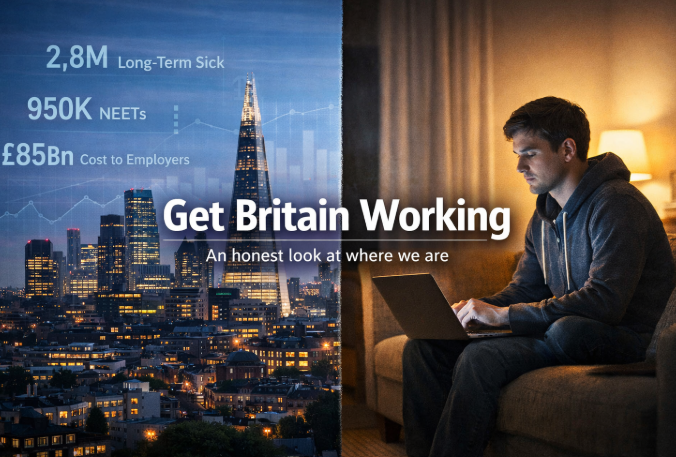
Get Britain Working and Keep Britain Working: An Honest Look at Where We Are
Britain has an employment problem, but it’s not the one that makes headlines. Unemployment is relatively low. The issue is the millions of people who’ve stopped looking for work altogether.
Since 2019, 800,000 more working-age people have dropped out of the workforce due to health problems. Long-term sickness now keeps 2.8 million people at home. Nearly a million young people aren’t in education, employment or training. Add it up and more than one in five working-age adults are out of work and not looking.
This costs everyone. The person who leaves work at 22 due to ill health could end up over £1 million worse off across their lifetime. Employers lose £85 billion a year through sickness absence and turnover. The state spends £212 billion annually on the consequences. Without change, another 600,000 people could fall out of work by 2030.
The government’s response came in late 2024 with two linked initiatives.
Get Britain Working is the policy programme: reforming jobcentres, guaranteeing support for young people, testing new approaches in local areas. Keep Britain Working, led by former John Lewis chair Sir Charlie Mayfield, focuses on what employers need to do differently.
We’re now over a year in. Programmes are running, money is flowing and reports have been published and responded to. So, let’s take a look at where things actually stand, what’s progressed, what’s stalled and what still isn’t working.
The initiatives break down into several key programmes, each targeting different parts of the problem. Here’s how they’re performing so far.
Connect to Work: Live, But Patchy
Connect to Work is the new programme for helping people with disabilities and those with health conditions into employment. It launched in mid-2025 and is now running in dozens of areas, backed by £338 million to support over 85,000 people.
The model makes sense. It’s called “place, train, maintain” — help someone find the right job, train them in what they need, then keep supporting them so they don’t fall out. The evidence on supported employment is solid when it’s done properly.
The problem is rollout. Some areas were ready last summer, others are still mobilising six months later. “Phased rollout shaped by local authorities’ own timetables” sounds like flexibility. In reality it means someone in Gloucestershire has been getting support since July while someone in a neighbouring area is still waiting.
And there’s a recruitment crunch. The programme needs Employment Specialist Coaches with genuine expertise in supported employment. Those people aren’t easy to find. Several areas are struggling to build teams fast enough to hit their targets.
The architecture is there. Whether it delivers is another question.
Youth Guarantee: Extended, But Where’s the Evidence?
The Youth Guarantee is the government’s promise that every young person aged 18-21 will have access to a job, an apprenticeship, or training. Rather than roll it out nationally straight away, the government set up eight “trailblazer” areas to test what works: Liverpool, West Midlands, Tees Valley, East Midlands, West of England, Cambridgeshire and Peterborough, and two in London.
These have been running since spring 2025 and last August, the government extended funding by another £45 million, taking the programme through to March 2027. That’s either confidence in the approach or acknowledgment that one year wasn’t enough to prove anything.
Different areas are trying different things, including giving free bus passes and mental health support and focusing on young people who grew up in care.
However, we’re nearly two years in and we can’t tell which approaches work. The point of trailblazers is to figure out what works before going national. If the learning isn’t being shared, what’s the point?
Meanwhile the numbers haven’t shifted. The latest data shows 948,000 young people still not in education, employment or training. That’s roughly where we started.
The Jobcentre Overhaul is Years Away

One of the headline announcements in the original white paper was merging Jobcentre Plus with the National Careers Service to create a proper “jobs and careers service.” The vision was compelling: transform jobcentres from places that police benefit claims into places that actually help people build careers. Use AI to personalise support. Create a “Jobcentre in your pocket.”
The reality is slower. According to what the Department for Work and Pensions told Parliament, the actual timeline is:
- 2025-26: run trials in a few places
- 2026-27: roll out what works, start integrating the two services
- 2027-28: launch the digital offering
So we’re looking at 2028 before anything like the original vision exists at scale. Right now there’s a small pathfinder in Wakefield and some prototype work happening.
The Work and Pensions Select Committee has criticised the lack of detail. Unions are worried about jobs and the £55 million allocated for development doesn’t have a clear spending plan. It’ll happen eventually, but anyone expecting transformation soon will be waiting.
The Employer Agenda is Progressing
The Keep Britain Working strand has moved faster than expected.
Sir Charlie Mayfield’s review made a compelling case. The system for managing sickness at work is broken. The “fit note” that doctors give people is supposed to explore what adjustments might help someone stay in work, but 93% just say “not fit” and leave it there. There’s a culture of fear where employees won’t disclose health problems because they’re worried about the consequences, and employers don’t ask because they don’t know what to do with the answer. People fall out of work who didn’t need to.
The review proposed a “Healthy Working Lifecycle” standard that employers could get certified against, a network of providers to help with case management, and a central unit to gather evidence on what actually works.
The government accepted the findings. Over 60 major employers signed up as “Vanguards” to test the new approaches with Tesco, John Lewis, and Aviva among them. Mayfield is co-chairing a taskforce with ministers. The Workplace Health Intelligence Unit is being set up.
This is real momentum. The question is whether it reaches beyond big companies with HR departments and dedicated budgets. But compared to other parts of the agenda, the employer-led work is probably furthest along.
The Controversy Nobody Wants to Discuss
Then there’s Pathways to Work.
In March 2025, the government published a Green Paper proposing significant changes to disability benefits. The details are technical but the direction is clear: make it harder to qualify for certain payments, and reduce the amounts for others.
The response was fierce. Nearly 48,000 people submitted consultation responses. Disability Rights UK, Scope, Trussell, and pretty much every organisation working with disabled people opposed major parts. The Work and Pensions Select Committee called for delays. There was a petition to scrap the whole thing.
The government made some changes to protect certain groups but hasn’t shifted the basic direction.
Get Britain Working and Connect to Work are supposed to help disabled people into employment by removing barriers and providing support. Pathways to Work is simultaneously cutting the income that disabled people rely on while they’re looking for work.
These two things pull in opposite directions. Financial stress doesn’t make job searching easier. Someone worried about rent because their benefits got cut isn’t in a great headspace to engage with employment support.
If you work in this space, you’re thinking about this. Pretending the conflict doesn’t exist doesn’t help anyone.
What Still Hasn’t Been Solved
Step back from the individual programmes and some fundamental problems remain.
There aren’t enough people to deliver any of this. Connect to Work needs specialist coaches. Youth Guarantee needs skilled youth workers. The transformed jobcentres need work coaches who can do career guidance, not just benefit compliance. These people don’t exist in sufficient numbers and nothing in the policy creates more of them.
The people who most need help aren’t engaging. Every programme assumes some baseline willingness to turn up. But the hardest groups don’t turn up. Young people with anxiety who can’t face appointments. People who’ve been out of work so long they’ve given up. People who don’t trust services because of past bad experiences. Making support available isn’t the same as making it accessible.
Everyone talks about early intervention but nothing is designed for it. The Keep Britain Working review made the point clearly: people off work for more than a year are five times less likely to return. Catch someone in the first weeks of a health problem and you’ve got a decent chance of keeping them in work. Wait until they’ve been home for a year and you’ve probably lost them.
But most provision is still set up for people who are already long-term inactive. Reaching people early means integration with employers and health services that doesn’t exist yet at any scale.
Where Does Technology Fit?
The white paper talks about AI and digital services as part of the future.
The useful question is: what can technology do that humans can’t, or can’t do at scale?
Availability is one thing. Traditional services have office hours. But someone lying awake at 3am worrying about their future needs help then, not in three weeks when an appointment opens up.
Capacity is another. There will never be enough advisers to give everyone intensive one-to-one support. If technology handles groundwork — initial conversations, skills exploration, goal setting — human time can go to the people who need it most.
Reach matters too. Some people will never walk into a jobcentre or youth hub. It’s not that they don’t want help. The format doesn’t work for them. Anxiety. Past bad experiences. Not seeing themselves as the “type” who goes to those places. Meeting them on their phone, on their terms, can get to people that traditional services miss.
At Saffron we’ve been working on this for a while. Our Create Your Own Future (CYOF) platform is designed around these specific problems.
CYOF really is a “Jobcentre in your pocket” – but better.
It uses AI in multiple ways – to enable conversation with a digital coach, to analyse transferable skills and match them to job profiles in the National Careers Service framework, match to live job boards and career mapping and also to accredited training. It generates a personalised action plan to help each milestone be broken down into manageable steps using a coaching model.
It reduces the time work coaches have to spend on the mundane aspects of their role and enables them to use the data from the user’s to assess confidence, feelings of control and commitment as well as see user activity. It enables them to use their skills to do what they do best – motivate, encourage and guide.
In the meanwhile, nudges and reminders from the platform as well as 24/7 help keep momentum going.
It’s already being deployed in the Cambridgeshire and Peterborough Youth Guarantee trailblazer now. Peterborough United Foundation opened their Youth Employment Hub in November and CYOF is part of how they’re reaching young people who might not engage with traditional services. It addresses specific gaps that the current system struggles with.
What Happens Next?
The next year will show whether Get Britain Working and Keep Britain Working deliver more than previous initiatives.
Connect to Work needs to demonstrate actual outcomes, not just participant numbers. Youth Guarantee needs published evidence on what’s working before anyone talks about national rollout. The jobcentre merger needs to speed up and get clearer. The Vanguard employers need to show that workplace health approaches work beyond big corporates.
For those of us delivering services, the job is building things that work within the system we’ve got, while being honest about what it still can’t do.
If you’re involved in Youth Guarantee delivery, Connect to Work, or writing a Local Get Britain Working Plan, and you’re wrestling with any of this, we’d be happy to talk.
If you’re curious whether CYOF could work for your area, we’re happy to walk you through it.
Get in touch with us to see how it works.

25 years of Beautiful Problems and Human Potential
A reflection by Noorie Sazen, CEO of Saffron Interactive
Twenty-five years is a long time to spend asking one question: why do people resist learning so fiercely, and yet crave it so desperately when it matters? That paradox has kept me fascinated since Saffron Interactive first opened its doors in 2000.
Hanif’s Vision: A Pioneer at the Dawn of Digital Learning
Saffron was founded by my late husband, Hanif Sazen. He was an early entrepreneur in digital learning, a man deeply passionate about education, and convinced that technology could unlock human potential. In 1999, CD-ROMs were cutting-edge, broadband was a luxury, and mobile learning was still science fiction. Hanif looked at this clunky, dial-up world and saw a future where learning was personal, purposeful, and powerful.
His sudden passing in 2010 was a devastating loss, both personally and for the company. Stepping into the role of CEO wasn’t simply about keeping the lights on – it was about carrying forward a vision that learning could be more than compliance, more than “click next to continue.” It could actually matter.
The Great CD-ROM Delusion (And Other Misadventures)
Back then, organisations were convinced that a spinning logo and some clip art could transform mind-numbing training into blockbuster entertainment. We rode that wave –– but having a consultancy background, we knew something the industry had overlooked: people don’t resist learning because it’s boring, they resist because it feels pointless. Once you give it meaning, behaviour changes. It’s the difference between owning a sports car and remembering you need petrol to make it go.
Transforming Organisations, One Contradiction at a Time
Working with clients has been a masterclass in human contradictions.
Transport for London showed us this in the starkest terms. The people taking our programmes weren’t anonymous Londoners – they were TfL’s own frontline teams: train drivers, track workers, station and platform staff. In a traditionally macho, safety-critical environment where talking about mental health had been quietly stigmatised, something counterintuitive happened.
Inside a well-designed digital space – with structure and a little anonymity – colleagues began speaking honestly about stress and resilience. The programme didn’t just lift wellbeing scores; it helped reset the conversation so people felt permitted to ask for support.
Hilton taught us that luxury isn’t champagne and caviar – it’s the predictability of excellence, everywhere, every time.
BT showed us that scale doesn’t have to crush individuality if you design learning like jazz rather than a marching band: structured, but with room for improvisation.
Nesta and the Department for Education inspired us to pioneer AI employment coaching two years before Chat GPT was released to the public and realised our dream to make learning at the heart of social mobility.
Awards and “Participation Trophies”
The industry loves handing out trophies for “innovation” and “learner engagement.”, and other shiny metrics. Nice to have, sure. But what we really need are awards for things like “actually changed behaviour” or “didn’t waste everyone’s time.”
Our Comic Relief project on violence prevention came close to that ideal – not just recognition, but genuine social impact and a change to government policy. That’s when learning stops being corporate virtue-signalling and starts being a force for good.
People, Misfits, and Makers
Behind every breakthrough has been a team of brilliant misfits. Instructional designers who treat learning like disguised therapy, developers who look at a perfectly functional system and ask, “But what if we made it weird?” and consultants who can walk into a boardroom and politely suggest everything is upside down. Together, they’ve created a culture that thrives on productive disobedience and an almost suspicious passion for making learning matter.
The AI Revolution: Systems That Finally Understand Us
Now, with AI, we’re entering the era where technology is finally catching up with what we’ve always known about people: we’re predictably irrational. Traditional systems treated humans like broken computers. AI, at its best, treats us as brilliant biological machines that need understanding, not fixing. That shift changes everything. Suddenly, we’re not forcing people to learn – we’re designing systems that make learning feel inevitable.
Looking Forward
As I look back on this journey – from Hanif’s pioneering vision to today’s AI-powered possibilities – I’m grateful. For the man who made it happen. For clients who let us experiment on their biggest challenges. For the team who make the impossible look easy.
And for the reminder, year after year, that combining empathy with technology doesn’t just change how people learn. It changes how they grow, perform, and contribute to something larger than themselves.
So here’s to 25 years of beautiful problems, frustrating paradoxes, and the delightful realisation that in a world obsessed with artificial intelligence, the rarest resource is still genuine human understanding.
Let’s carry that into 2026…and beyond.

Peterborough Football Foundation launches Saffron Interactive’s AI Platform Create Your Own Future
Create Your Own Future used in DWP’s Trailblazer Youth Guarantee scheme at the POSH
Peterborough United Foundation has launched Create Your Own Future, as part of DWP’s Youth Guarantee Trailblazer programme. This initiative explores innovative approaches to support young people to move into work, education, or training.
As one of the first Trailblazer projects, the Foundation’s use of Create Your Own Future represents a bold step forward in using cutting edge artificial intelligence to enhance a work adviser’s ability to deliver highly personalised employability support.
What is Create Your Own Future?
The platform enables participants to engage in natural conversations with a digital mentor, helping them reflect, build confidence, assess transferable skills, and set clear goals. It then provides tailored recommendations for training, work experience, or education.
Real-time analytics empower advisers at the Foundation and the Department for Work and Pensions (DWP), to monitor progress, understand motivation, and deliver timely interventions. This approach represents a new model for employability and upskilling. It fuses human empathy and digital intelligence with the scalability and personalisation of AI.
The Foundation’s CEO, Gill Wignall, said “Football clubs have a special place in their communities. We can reach and inspire people others can’t. By adding Create Your Own Future to our toolkit, we’re bringing cutting-edge technology directly into our community programmes. This approach offers a replicable model for other clubs, foundations, local authorities, and employability providers seeking to innovate and make social impact.”
The community hub was officially opened on 6th November by the Mayor of Cambridgeshire and Peterborough, Paul Bristow, alongside the Rt Hon Pat McFadden, Secretary of State for Work and Pensions.
The Youth Trailblazer
“The Trailblazer programme exists to test new approaches — and that’s exactly what Create Your Own Future delivers” stated Noorie Sazen, CEO of Saffron Interactive. “We are very proud to partner with the Foundation to help youth shape their own journey, giving them a sense of ownership, purpose and agency that traditional programmes can’t match. This is the best of AI and human working together for the next generation of employability support.”
About Create Your Own Future
Create Your Own Future is a holistic, AI-enabled employability solution from Saffron Interactive. It personalises the learning and job-seeking journey through adaptive AI, voice-based reflection, skills assessments, job matching, and personalised action plans — all visualised via intuitive dashboards for both users and advisers. It takes away the administrative aspects for advisers so they can concentrate on more timely empathetic support and guidance to participants; leading to improved outcomes.
Learn more: Employability Solutions
About Peterborough United Foundation
Peterborough United Foundation is the registered charity of Peterborough United FC. It delivers sport, health, education and inclusion programmes across the city and region, using the power of football to change lives.
Press contact
Douglas McDonald, Performance Consultant
Saffron Interactive Ltd
+44 (0)20 7378 3300
info@saffroninteractive.com


The real reason cybersecurity strategies keep falling short
How better learning design creates the behaviour change most programs miss — and what real results look like
The risk isn’t tech… it’s us
In recent weeks, three of the UK’s most recognisable high street retailers — Harrods, Marks & Spencer, and the Co-op — were hit by cyber attacks. These aren’t small operations. These are household names with global reputations, sophisticated infrastructure, and serious security investments. Unfortunately, the impact on their operations and customer data was very real.
And yet, the breaches happened. Not through some clever backdoor exploit or elite-level hack — but through people. A phishing link. A moment of misplaced trust. A lapse in judgment.
It’s a sharp reminder: no matter how strong your firewalls are, human behaviour is still a critical vulnerability.
If retailers of this scale can be compromised, what does that say about the everyday risk inside your own organisation? And more importantly — is your compliance training really preparing people for this?
Knowing the rules isn’t the same as following them
Many moons ago, I had a music teacher who was walking me through some basic jazz concepts when he said something I’ve never forgotten. He said: “You need to know the rules to break the rules.”
He was talking about introducing tension, using notes that technically shouldn’t work, and resolving them in a way that somehow not only worked but worked well. You can’t pull that off unless you truly understand the context and intention behind what you’re doing. That lesson has stayed with me. And it applies just as much to compliance learning as it does to music.
In many organisations, people ‘know’ the rules. They’ve completed the training programs and passed the quiz. But in real-world moments, under pressure or when facing a cleverly disguised scam, they don’t know how to apply them.
 Numbers don’t lie, but they don’t protect you either
Despite widespread investment in cybersecurity training, research shows that human behaviour remains the weakest link. The UK Government Cyber Security Breaches Survey 2021 reveals that around 27% of businesses and 23% of charities face cyber breaches weekly, with 83% of attacks involving phishing and 27% impersonation scams.
The training landscape also seems unfortunately bleak. Traditional compliance training often misses the mark. PwC’s 2024 Global Digital Trust Insights survey found that the proportion of businesses experiencing data breaches costing over $1 million has increased from 27% to 36% year-over-year. The survey also highlights key concerns around cloud threats, hack-and-leak operations, third-party breaches, and attacks on connected products — areas where organisations feel least prepared. Importantly, 40% of business leaders say they don’t know how to respond effectively to new and emerging digital threats, underscoring a critical gap in leadership readiness.
But what does this mean for training? Completion doesn’t equal comprehension — and even comprehension doesn’t always lead to action. They say not all heroes wear capes, but when it comes to defending against increasingly sophisticated digital threats, we need well-equipped human responses: people with the right skills, mindset, and judgment under pressure (capes optional, budget permitting).

A false sense of security
For many compliance leaders, the frustration is clear: training gets completed, but it doesn’t translate into real-world impact. The boxes are ticked. But on the ground? The same breaches. The same moments of poor judgment. These aren’t random occurrences, they’re symptoms of a deeper misalignment between what’s taught and how people behave when it matters.
According to Gartner, organisations with a strong compliance culture are nearly 2.5 times more likely to achieve positive business outcomes. Yet, 87% of employees say they don’t work in a strong ethical culture at all, according to the Ethics & Compliance Initiative’s 2023 Global Business Ethics Survey. That gap matters. Because culture is compliance. And when it’s weak, rules won’t transfer to behaviour.
But there is hope. PwC’s Global Compliance Study 2025 found that leading compliance programs are far more likely to tailor their approach to the unique needs of the organisation, leverage data to continuously improve, and benchmark their efforts against industry standards. These aren’t just operational tweaks—they’re vital for reducing risk and fostering a culture of accountability. This isn’t about employees not caring; it’s about making compliance meaningful, connecting policy to real-world challenges, and empowering individuals to do the right thing even when no one is watching.
Purposeful learning design should always be the driver
Real compliance training needs to go further — drawing on insights from behavioural science to influence not just what people know, but what they do. This means designing learning experiences that connect with how people make decisions. It means understanding the learner’s reality: their work environment, their pressures, the shortcuts they’re likely to take, and how compliance manifests in the day-to-day.
Effective training doesn’t just transfer information, it builds habits, strengthens judgement, and boosts confidence to do the right thing. When learning is relevant, interactive, context-aware, and easy to apply, it transfers to how people go about their day-to-day work. It’s not something extra—it’s natural…
Let’s make compliance work. If you’re asking how to reduce risk with better staff training or struggling to shift your compliance learning strategy, you need a fresh perspective on what’s possible. We’d love to share how we’ve worked with the likes of Barrick Gold, International Airlines Group, and Coca-Cola, to name just a few, and shaped strategies that change behaviours and embed compliance in organisational culture.
Get in touch, and let’s turn good intentions into confident actions.

Your compliance training needs a culture shock
Half of all businesses are now optimising their compliance programmes to create a compliance culture. Not just to stay on the right side of the law, but to protect their people, their reputation and because the security of their business is a priority.
This year, 75% of organisations increased their compliance budgets to stay aligned with the rapidly shifting regulatory landscape. One major update? The Data Use and Access Act 2025, which presents more severe fines for breaches of Privacy and Electronic Communications Regulations (PECR), with potential fines of up to an eye-watering £17.5 million.
In light of any new policies, the demand follows for updated training to ensure your people are aware of and can manage the associated risks. But how is such training typically received at your organisation? Disinterested expressions and begrudging obedience?
It might be awkward to admit your training is boring and ineffective, but many other employers are in the same boat. A striking 85% of employees feel disengaged during compliance training, and only 11% apply what they learn in the workplace. The problem isn’t just the content; it’s the approach.
Updating training materials to reflect new policies is a legal requirement. But reducing the risk of a phishing click or preventing a privacy breach requires more than knowledge. It requires behaviour change. To reduce real-world risks like phishing or data breaches, businesses must go beyond box-ticking and rethink their entire approach to compliance.
Making the change
AI has changed the game for cybercriminals.
Scammers can craft more believable emails, heightening the probability of an employee clicking on a seemingly innocent URL. Just one click could endanger the security of your business, and with over 3.4 billion phishing emails sent per day, employees are increasingly vulnerable to falling prey to these scams.
As technology advances, businesses must adapt, which means change. The “c-word” might fill some managers with dread and employees with apprehension, but without change and innovation, businesses lose relevance and revenue.
To keep up, many organisations are rethinking compliance training entirely. In fact, 70% of corporate risk and compliance professionals say their approach is evolving to match changes in policy and technology. This shift moves away from passive, text-heavy modules towards strategic, culture-driven learning that embeds compliance into the way people work every day.
A strong compliance culture moves beyond surface-level checklists and policies. It builds a workplace where everyone understands their role in upholding standards and is motivated to act accordingly. It encourages all members of a business to recognise that they are accountable for maintaining compliance in the workplace and should all be invested in the reasons for doing so.
Effective training plays a key role here. It should help employees:
- Recognise how their behaviours affect the wider business
- Understand the why behind compliance
- See the positive impact of their actions on colleagues and customers
When this understanding is in place, employees are more likely to act with care and accountability. They’re not just avoiding penalties, they’re taking pride in doing the right thing.

Motivation matters
The most sustainable compliance behaviours are driven by intrinsic motivation. This is when employees act appropriately because they want to, not because they’re told to.
Intrinsic motivation leads to better performance, higher engagement, and longer-lasting behavioural change. By contrast, extrinsic motivation (such as rewards or fear of punishment) wears off quickly. Once the incentive is gone, so is the behaviour.
Generating awareness as to the consequences of their actions on their co-workers promotes self-responsibility for employees and encourages them to adopt a ‘think before you do’ approach within the workplace, preventing incidents before they happen. The switch is flipped from viewing compliance as a set of rules to being intuitive and natural for employees.
When people see compliance as part of doing good work (not just something to avoid getting wrong!), it becomes second nature. It’s about creating the right mindset, not just delivering the right message.
The behavioural advantage
When compliance training focuses on behaviour change, the results go beyond risk reduction. Teams become more self-aware, more respectful, and more aligned in their goals. Motivation, satisfaction, and performance all improve. This is the competitive edge that many organisations are already working to create. In 2024, 50% of risk and compliance professionals described their programmes as mature, either managing or optimising. For those still relying on outdated models, the urgency to innovate is real.

The cultured way forward
Embedding a compliance culture takes time. But in today’s high-risk environment, delays can be costly. The good news is that it doesn’t all have to come from you.
At Saffron, we understand that lasting behaviour change requires more than one-off training. That’s why we created Charlie, an AI compliance coach that helps embed good decision-making into everyday work.
Charlie is available 24/7 to guide employees on reporting processes, policy interpretation, and everyday queries. Since its launch, businesses using Charlie have seen a 27% reduction in compliance concerns raised by staff. Employees feel more confident, and mistakes are reduced. It’s the difference between guessing and knowing. Between hesitation and action.
Charlie gives an additional layer of security and reassurance for your employees and your business, guiding them to always do the right thing.
Start the shift. Today.
Your next compliance update doesn’t need to be another tick-box exercise. It can be a turning point.
By investing in a culture-first, behaviour-led approach, you can reduce risk, improve performance, and future-proof your business.
Let’s make your compliance training truly effective and impactful.
Get in touch with us, and we’ll help your people get compliance right every time.


Myths and realities of AI in employment support | 3SC Webinar

Join us to explore what you need to know to maximise your employment support with AI!
In the quest to drive down inactivity and achieve 80% employment, we need a diverse, modern, and agile approach that meets local demands and encompasses work, skills, and health.
As we strive to meet the needs of participants, programmes, and commissioners, can digital enablers offer higher value support, better outcomes, and increased efficiency?
Saffron Interactive, the developer of the innovative Create Your Own Future platform, invites you to discover how digital innovation can transform your approach to employment support. This session will explore how AI can:
- Provide an enriched experience and better outcomes for supported individuals
- Increase efficiencies by reducing administrative burden and supporting advisors
- Reduce costs whilst maintaining a quality service
- Deliver unparalleled data analysis and insight
- Pioneer the future of employment support, today.
Grab your copy of the slides and catch-up on demand for your opportunity to learn how AI can create a brighter future for our participants.
Want to explore the difference digital technology could make to your employability and ESG programmes?
Leveraging AI in your organisations skills-based strategy | LT Webinar
A skills-based strategy powered by AI can future-proof your organisation. Are you ready to close the talent deficit and lead with skills?
Enterprise organisations are facing an urgent challenge: a widening talent gap that threatens business resilience. While traditional job roles and credentials fall short, skills-based strategies – powered by AI – are emerging as a powerful solution.
As the shift towards becoming a skills-based organisation gains momentum, now is the time to take action in becoming a skills-based organisation.
Catch up and download the slides to explore:
- 🔍 Why business leaders are turning to AI to accelerate skills transformation
- 🧠 How to implement a skills-based strategy that’s agile and future-ready
- 🧩 What critical skills gaps you may be overlooking and how to close them
Whether you’re just starting your transition or looking to supercharge existing efforts, this session will equip you with the tools and frameworks to rethink talent in a world of accelerating change.
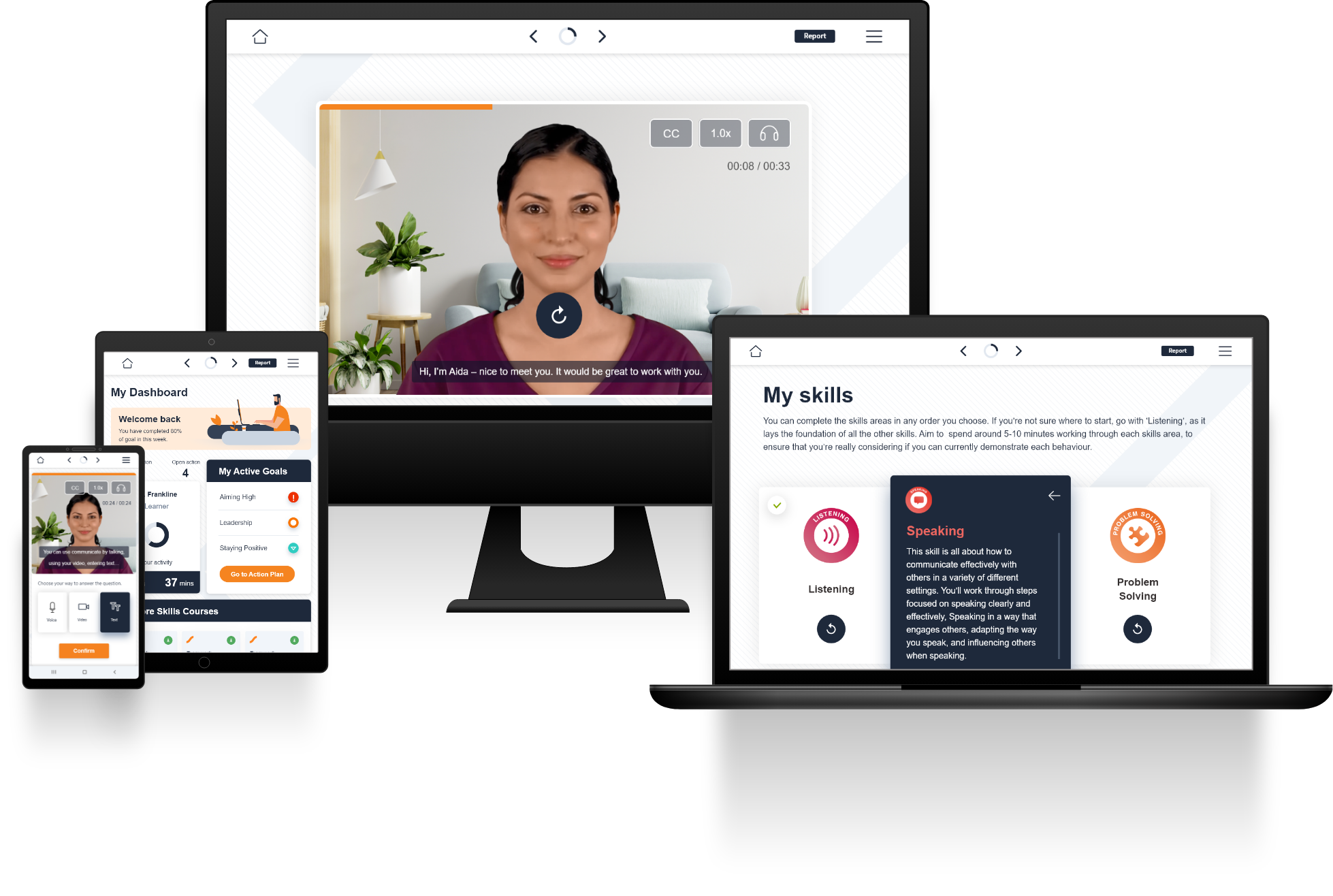
Want to find out more?
To explore how Saffron's AIDA could increase workplace performance through effective and scalable coaching, request your personal introduction using the link below.
Saffron Interactive Shines as ‘Solid Performer’ in 2025 Fosway 9-Grid™ for Digital Learning
Saffron Interactive, a leading innovator in digital learning solutions, proudly announces its recognition as a ‘Solid Performer’ in the 2025 Fosway 9-Grid™ for Digital Learning.
This accolade reaffirms Saffron’s dedication to transforming learning experiences through pioneering AI-driven solutions and behavioural science methodologies.
The Fosway 9-Grid™ is an independent analysis of the digital learning market, evaluating providers across five dimensions: Performance, Potential, Presence, Total Cost of Ownership, and Trajectory. Saffron’s placement on the grid underscores its consistent delivery of impactful, scalable, and cost-effective learning solutions that drive real business transformation.
“Our continued recognition on the Fosway 9-Grid™ reflects the measurable impact we create for our clients,” says Noorie Sazen, CEO of Saffron Interactive. “At Saffron, we harness the power of AI and behavioural science to design truly personalised and performance-driven learning experiences. We are proud to be at the forefront of this evolution and remain committed to pushing the boundaries of digital learning.”
“Despite challenging economic times, organisations are very focused on the need to upskill and reskill their workforce,” said David Wilson, CEO and founder of Fosway Group. “Saffron has a long track record of delivering solutions that impact performance and are recognised as a Solid Performer in 2025.”
Saffron’s flagship AI-powered skills coach, AIDA, exemplifies the company’s commitment to innovation. AIDA is designed to accelerate upskilling and reskilling efforts within organisations, with learners reporting confidence boosts of up to 92%. By seamlessly integrating AI into skills development, Saffron ensures that organisations remain agile and competitive in an ever-changing talent landscape.
Saffron will be showcasing AIDA at the upcoming Learning Technologies Exhibition and Conference on the 23rd & 24th of April, where attendees can experience firsthand how AI-driven coaching transforms skills development.
The 2025 Fosway 9-Grid™ ranking marks another year of excellence for Saffron Interactive, reinforcing its position as a trusted partner for organisations seeking cutting-edge digital learning solutions.
To learn more about AIDA, and why Saffron has remained at the forefront of innovation in digital learning throughout the last 25 years, get in touch with one of the team.
About the Fosway 9-Grid™
Fosway Group is Europe’s #1 HR industry analyst, providing independent insights on HR, talent, and learning technology markets. The Fosway 9-Grid™ offers a comprehensive assessment of key solution providers based on extensive research and input from Fosway’s Corporate Research Network, which includes over 250 leading organisations such as BP, HSBC, PwC, Shell, and Vodafone.
For more information, visit www.fosway.com.

Empower employability with AI in Connect to Work | Infographic
Empower effective employment support with AI in Connect to Work
A guide by Saffron Interactive

How are you using AI to enrich your Connect to Work delivery, enable higher value support and deliver better outcomes?
If you are going to balance participant needs, local labour market demands and programme criteria, it is critical that you are prepared to deliver diverse, modern and agile services to your communities.
Imagine if digital technology could seamlessly collaborate with your employment specialists, participants, and employers to bridge gaps and ensure success for every individual… Well it can!
If you’re ready to explore how you can amplify the impact of your high-fidelity support programs through effective and scalable digital innovation, download your free guide today!
Want to explore the difference digital technology could make to your employability and ESG programmes?
Empowering employment support with AI | ERSA Webinar
Empowering employment support with AI
Webinar | ERSA and Saffron Interactive
In the quest to drive down inactivity and achieve 80% employment, we need a diverse, modern, and agile approach that meets local demands and encompasses work, skills, and health.
As we strive to meet the needs of participants, programmes, and commissioners, can digital enablers offer higher value support, better outcomes, and increased efficiency?
Saffron Interactive, the developer of the innovative Create Your Own Future platform, invites you to discover how digital innovation can transform your approach to employment support. This session will explore how AI can:
- Provide an enriched experience and better outcomes for supported individuals
- Increase efficiencies by reducing administrative burden and supporting advisors
- Reduce costs whilst maintaining a quality service
- Deliver unparalleled data analysis and insight
- Pioneer the future of employment support, today.
Grab your copy of the slides and catch-up on demand for your opportunity to learn how AI can create a brighter future for our participants.
Want to explore the difference digital technology could make to your employability and ESG programmes?

Get Britain Working – will it be what the country needs?
A week has passed following the 2024 Budget and whilst historic in the scale of the tax raising, as well as the delivery of the budget by a female; there is little clarity on the announcement of the Get Britain Working plan.
The white paper is still expected in “Autumn” with no confirmation of it’s launch date. But as the nights draw in and days get chillier, Autumn is officially over at the end of November.
As a result, the employment sector lies in wait. Anticipating the announcement that will shape the central role we will play in delivering the Government’s ambitious 80% employment rate. Whatever the form, this plan must tackle economic inactivity and enhance employment opportunities across the UK. To achieve this, it appears that 8 “Trailblazers” will be launched for adults and 8 for the youth.
But what age range will the youth cover? How will the Trailblazer pilots bring together the various government departments to commission these? How will the merger of the National Careers Service and Job Centres feature? Will it be motivational to work if the National Insurance payment band is lowered? Does current commissioning allow for the innovation required to deliver higher value support, better outcomes and increased efficiency? Will devolution to local areas support these overall aims?
Or is there a more radical approach that is needed?
A holistic approach
The government’s £240 million Get Britain Working package aims to integrate work, health, and skills support, particularly for disabled individuals and those with long-term illnesses. With 2.8 million people out of work due to long-term sickness, and a dearth of people with skills in the marketplace, this approach is a positive step. But the effectiveness of these measures will depend heavily on their execution and the resources allocated to local services.

One of the key components of the initiative is the introduction of “Trailblazers” in local areas. These Trailblazers are designed to streamline work, health, and skills support, ensuring that individuals receive comprehensive assistance tailored to their specific needs.
However, we are yet to understand the practicalities of this programme. As services are further devolved, could this add complexity to those delivering support and the individuals receiving it? As a sector, many of us already face challenges in the current commissioning processes. To ensure success, these initiatives will require robust coordination between various agencies and sufficient funding to support their implementation. It is vital that this is addressed by Commissioners.
The digital context
In this context, digital solutions can play a pivotal role. With the potential to transform the way employment support is implemented; technology can join up services, making delivery more accessible and efficient.
For instance, with AI, it is now possible to provide 24/7 support and guidance, allowing individuals to access high quality help whenever they need it. This can be particularly beneficial for those with irregular schedules or who may face barriers attending in-person. In addition, many platforms are now built to straddle multiple initiatives and bifurcate based on an individual’s responses. This allows digital technology to provide individuals with tailored guidance that addresses their unique circumstances, but also recommend personalised pathways or suitable programmes based on the information gathered. All this without relying on administrative effort from advisors who can better deliver expertise and motivational support to their audience.

As we navigate the next steps of Labour’s inaugural plan, alongside the leftovers of Restart, Access to Work and many more legacy initiatives, clarity and consistency is key. Get Britain Working is the goal, but doing so means providing clear structure and implementation to ensure that, we can deliver “Employment Support for Every Citizen”.
The key to success
Cohesive, effective integration must involve an element of innovation. Not every delivery model is built to operate alongside digital, but as demand grows for a diverse offering, services must be agile. This must involve an element of aligning digital tools with the workflows of existing programmes, as well as planning and embedding such tools into the core of contemporary contracts.
Research has shown that 74% of individuals prefer a digital solution when exploring personal or sensitive topics, rather than face to face in the first instance. We as a sector must respond and provide services that meet individuals where they feel most comfortable. If we can, our provision will be much more impactful; maximising engagement and outcomes for all those we serve.
However, equally important is the buy-in from delivery staff. For digital solutions to be effective, our advisors must be freed up to do what they do best – handhold the participants on their journey. Digital tools can take away the administrative burden they face and leverage the data insights in order to deliver more personalised and impactful support.
Proven impact and future potential
Saffron’s Create Your Own Future has already demonstrated significant impact for both participants and providers. The unique transparency and streamlined administration can reduce burden on work coaches by 70% and boost user confidence by 92%, whilst also achieving 100% user satisfaction. As the government accelerates benefit reforms and rolls out local services to help people back into work, it is crucial to leverage innovative digital solutions like Create Your Own Future to build a more inclusive, supportive, and productive employment landscape.

While the government’s initiatives are a step in the right direction to Get Britain Working, their success will depend on careful implementation and the effective use of digital tools to not only support individuals on their employment journey but provide effective data on their initiatives’ impact and value for the public purse. Otherwise, the high tax take will only push the country into further decline.
Get in touch to explore how you can increase job satisfaction for advisors, provide an enhanced experience for the supported individual and pioneer the future of employment support in your organisation – today.


Trick or t(h)reat: cyber security and the case of the cursed click
Hey there, brave readers! As the leaves fall and the nights get longer, there’s a chill in the air… and it’s not just because Halloween is around the corner. It’s October, which means it’s Cyber Security Awareness Month. A time when we shine a flashlight into the dark corners of the internet, where things go bump in the night and passwords mysteriously disappear into the ether… or, more accurately, into the hands of hackers. 👀
So, grab your pumpkin spice latte, turn off the lights (but, you know, not your firewall), and gather ‘round. We’re about to share some spine-tingling tales of cyber security terror and how you can avoid becoming the next cyber ghost—haunting the halls of LinkedIn, whispering about how you “used to have data…”
The Case of the Cursed Click
Once upon a time, in an open-plan office not so far away, Susan from HR received an email. “Free Pizza Lunch for All Staff!” the subject line screamed. Pizza? For free? Who could resist such a delicious offer?
Susan clicked. Oh, Susan…
What she didn’t know was that her innocent love for carbs had unleashed a phishing curse upon the company. Suddenly, the lights flickered, files vanished, and HR documents were held hostage in exchange for a hefty ransom in Bitcoin. The pizza? Never came.
🔐 Moral of the Story: Always double-check before clicking links. Hover over URLs like you’re inspecting a suspicious potion label, cyber security risks come in many costumes. But if it smells fishy, it’s probably phishing.
The Phantom Wi-Fi
Late one evening, Amanda the Accountant found herself working from a quaint little café. It was a charming spot—cozy lighting, indie music, and an open Wi-Fi network called “FreeCoffee_Wifi.” She connected, feeling pleased with her productivity.
What Amanda didn’t realise was that lurking in the digital shadows was a rogue hotspot, a honeytrap set up by a cyber security spectre waiting to steal her information. As she sipped her latte, her private data danced across the open network, right into the hacker’s hands.
Amanda didn’t even notice the breach until weeks later when her identity was stolen, and her bank account was drained to buy hundreds of… haunted clown figurines? Shudder.
🔐 Moral of the Story: Beware of public Wi-Fi networks! Always use a VPN when connecting to unfamiliar networks. Without it, you’re basically handing out your data like candy on Halloween.
The Ransomware on Elm Street
In a quiet office block, all was well until one fateful Friday. Tom, the tech-savvy team lead, noticed a pop-up on his screen. “Your files have been encrypted. To free them, transfer £5,000 in Bitcoin to the following address. You have 48 hours before your data is gone… forever. 🧛♂️”
Tom’s heart raced. This was it—ransomware, the digital vampire of the cyber world. It had infiltrated the company’s system through an outdated software vulnerability. The IT department scrambled, but it was too late. The data was locked tighter than a tomb.
🔐 Moral of the Story: Keep your software updated and back up your data regularly. If not, you may find yourself paying a high price to get your files back from the undead.
How Can You Protect Your Workforce From These Cyber Ghouls?
Cyber security doesn’t have to be scary, but it does have to be smart. The true horror? Lost productivity, extra training, and valuable resources spent on recovery. These disruptions can hit workforce performance hard. It’s all about educating yourself—and your team—before the hackers come knocking like trick-or-treaters with no intention of leaving.

And hey, wouldn’t it be great if you had some sort of magical eLearning content tailored to your specific needs, teaching your team how to avoid falling victim to these cyber frights? Well, you’re in luck… It’s possible to equip your team with the cyber security skills they need to tackle phishing scams, weak passwords, and those dreaded “reply-all” mishaps.
Saffron’s bespoke learning solutions go beyond compliance, genuinely engaging employees to prevent costly mistakes. Make cybersecurity a core part of your culture to reduce human error, minimise downtime, and save valuable hours.
For now, stay safe out there in cyberspace! Keep your passwords tight, your firewalls tighter, and may your October be filled with more treats than tricks.
Happy Cyber Security Awareness Month! 🎃
(P.S. If you need help warding off the digital vampires and ghosts, you know who to call… 👻 Just get in touch with one of our ghostbusters, here).

Using AI for more than content generation | LT24 Seminar
To develop a strategy that supports your organisation in creating value and improving performance, leveraging coaching to accelerate skills development is critical. But what is the role of AI?
To thrive, organisations must use AI as a strategic partner in their workforce development strategy. By combining conversational AI with tested and proven coaching techniques, you can deliver tangible performance improvement and accelerate skills development.
Saffron’s Noorie and Molly explore this topic in this Learning Technologies Autumn Forum session. Enter your details below to catch up on the session and transform your strategy to use AI for far more than just content generation…
Catch up and download the slides to explore:
- The true opportunity of AI in untapping workplace performance
- How L&D can use AI enabled coaching to transform AND accelerate skills development
- Combining safety, reliability and effectiveness with our performance boosting skills coach, AIDA
- Using data insights to measure success, impact and drive results
This webinar will introduce AIDA 2.0, showing you how to pioneer workforce transformation and use your human capital as a competitive advantage.
Want to find out more?
To explore how Saffron's AIDA could increase workplace performance through effective and scalable coaching, request your personal introduction using the link below.

Saffron Interactive continues to shine as a ‘Strong Performer’ in 2024 Fosway 9-Grid™ for Digital Learning
Trailblazing learning technologies provider, Saffron Interactive, proudly maintains its position as a ‘Strong Performer’ in the prestigious Fosway 9-Grid™ for Digital Learning.
This recognition underscores Saffron’s unwavering commitment to excellence and innovation in the digital learning landscape.
Organisations present in the 9-Grid™ are subject to a rigorous five-dimensional analysis that assesses: Performance, Potential, Presence, Total Cost of Ownership and Future Trajectory. Used to understand the relative position of solutions and providers in the learning market, Saffron’s ranking can be attributed to strong results across all five measurables.
Solidifying their position on the grid for another year is testament to Saffron’s premium and highly bespoke approach to learning solutions. The entire team work to consistently surpass expectations whilst ensuring client outcomes are measured and achieved.
“Saffron’s success lies in our relentless pursuit of using innovation, with purpose,” says Noorie Sazen, CEO of Saffron Interactive. “We are thrilled to have maintained our position on the Fosway Grid after another fantastic year of delivering measurable impact for our partners. Our behavioural science methodology, combined with groundbreaking use of AI-enabled technologies, sets us apart and we look forward to continuing this development long into the future”.
Saffron recently attended the Learning Technologies Exhibition and Conference to showcase AIDA, their AI-enabled skills coach. Exemplifying Saffron’s approach and commitment to cutting edge solutions, AIDA is proven to deliver an increase in performance. With learners experiencing a boost in confidence of up to 92%, AIDA supports an acceleration of upskilling and reskilling across organisations.
To learn more about AIDA, and why Saffron is consistently considered a ‘Strong Performer’ in the digital learning landscape, get in touch with one of the team to request a personal introduction to your organisation’s new partner in coaching for skills.
About the Fosway 9-Grid™
Fosway Group is Europe’s #1 HR industry analyst. The Fosway 9-Grid™ provides a unique assessment of the principal learning and talent supply options available to organisations in EMEA. The analysis is based on extensive independent research and insights from Fosway’s Corporate Research Network of over 250 organisations, including BP, HSBC, PwC, RBS, Sanofi, Shell, and Vodafone.
Visit the Fosway website at www.fosway.com for more information on Fosway Group’s research and services.
Using AI for more than content generation | LT24 Seminar
According to the Global Sentiment Survey, AI is both the top trend and the biggest challenge facing L&D in 2024. How can you pioneer transformation to use AI as a strategic partner?
Most L&D departments are experimenting with AI for content generation and ideation. But this alone is not transformative for the business. L&D must use AI as a strategic partner, able to deliver tangible performance improvement and accelerate upskilling and reskilling.
Saffron’s Noorie and Molly explore this topic and the role AI can play in driving workforce productivity, performance and measuring the impact, in this seminar at Learning Technologies 2024. Enter your details below to catch up on the session and transform your strategy to use AI far beyond just content generation…
Catch up and download the slides to explore:
- The current use of AI in business operations
- How L&D can use AI to tackle critical workplace challenges and accelerate upskilling and reskilling
- Using data insights to measure success, impact and drive results
Combining practical tips and thought-leading research, this seminar will arm you with the tools you need to ensure your organisation can become people and performance centred – and measure the results!
Want to find out more?
To explore how Saffron's AIDA could increase workplace performance through effective and scalable coaching, request your personal introduction using the link below.

Using AI to manage compliance risk | LT24 Seminar
Using AI to manage compliance risk might sound like an oxymoron. In fact, within many organisations AI itself is often seen as an unmanageable organisational risk. But what if there was a way to mitigate that risk?
In an attempt to tackle the issues presented by AI, some companies have gone as far as banning access to AI tools within the workplace. Whilst also using sophisticated software to protect their business operations. But even with these efforts, in practice, people are often the biggest compliance risk facing organisations.
In this Learning Technologies 2024 seminar, Saffron’s Noorie and Molly explore this topic and the role AI can play in supporting a culture of compliance and managing the risk introduced to businesses by people themselves. Enter your details below to catch up on the session and transform your compliance strategy…
Catch up and download the slides to explore:
- A use case for AI in a heavily regulated industry that promotes learning at the point of need
- Using data insights to measure success, impact and drive results
- Whether an AI driven approach can provide real time risk management that even impresses regulators
Combining practical tips and thought-leading research, this seminar will arm you with the tools you need to change the culture of compliance in your organisation.

Using AI for more than content generation | LSG Webinar
Using AI for more than content generation | LSG Webinar
Thursday 7th March | 12pm to 1pm GMT

According to the Global Sentiment Survey, AI is both the top trend and the biggest challenge facing L&D in 2024. How can you pioneer transformation to use AI as a strategic partner?
Most L&D departments are experimenting with AI for content generation and ideation. But this alone is not transformative for the business. L&D must use AI as a strategic partner, able to deliver tangible performance improvement and accelerate upskilling and reskilling.
Saffron’s Noorie and Molly explore this topic and the role AI can play in driving workforce productivity, performance and measuring the impact, in this Learning and Skills Group webinar. Enter your details below to catch up on the session and transform your strategy to use AI far beyond just content generation…
Catch up and download the slides to explore:
- The current use of AI in business operations
- How L&D can use AI to tackle critical workplace challenges and accelerate upskilling and reskilling
- Using data insights to measure success, impact and drive results
Combining practical tips and thought-leading research, this webinar will arm you with the tools you need to ensure your organisation can become people and performance centred – and measure the results!
Want to find out more?
To explore how Saffron's AIDA could increase workplace performance through effective and scalable coaching, request your personal introduction using the link below.
Revitalising employability: Delivering impact with AI | eBook
Revitalising employability: Delivering impact with AI innovation
An eBook by Saffron Interactive
The world and the labour market are shifting rapidly, driven by ever-accelerating technological advancements. This rapid change only highlights a well known challenge: ensuring we deliver effective, impactful and sustainable employment support.
But could the expanding role of AI across the globe present a unique opportunity to revitalise and improve the support we offer our people?
We tackle this sector-shifting question in our exclusive eBook. Download your copy to delve into:
- The current challenges facing employment support and why the sector must consider drastic change
- Suggestions for reform sourced from across the industry and informed by experienced experts
- Exploring a practical solution, including thoughtful use of
AI-powered support systems
We combine the latest thought leading research in this piece with the aim of showcasing where and how the sector can collaborate to take action and ensure every individual has access to the support they need to develop their skills and find meaningful employment.
Want to explore the difference digital technology could make to your employability and ESG programmes?
Saffron’s AIDA shortlisted for coaching innovation at Learning Awards 2024
Built using groundbreaking AI enabled coaching innovation, Saffron Interactive’s skills coach, AIDA, has been selected as a finalist in the ‘Innovation in Learning – Platform’ category at the Learning and Performance Institute’s Learning Awards.
AI has more uses than just generating content. Saffron are pioneers in using AI to increase workforce productivity and performance by democratising coaching. As coaching is known to increase and accelerate skills development, Saffron’s AIDA offers a personalised coaching experience to every individual at a fraction of the cost, with highly effective results.
“We are thrilled to have been recognised for our AI coaching innovation at this year’s Learning Awards,” said Saffron’s Director, Noorie Sazen, when reflecting on the platform’s shortlisting. “We are working closely with businesses to integrate AIDA into their skills coaching programmes and measure the impact – something often unattainable with more traditional strategies”.
AIDA integrates voice, video and text recognition with sentiment analysis at an advanced level of AI to guide learners through a self-development journey. The platform’s 24/7 accessibility offers all-hours support as well as providing line managers with real-time data on performance improvement, which can be used to showcase measurable business impact.

By combining tested and proven learning techniques with pioneering coaching innovation, the AI enabled video coach motivates users to understand their own skillset, produce personalised development pathways and drive the uptake in utilisation of existing learning resources.
This recent shortlisting is the 2nd in just two months for AIDA, after the platform was also successfully selected as a finalist for ‘Most Innovative Product’ at the Learning Technologies Awards earlier this year. These accolades highlight Saffron’s continuous drive to use innovation with purpose. AIDA’s power in cultivating and restoring confidence and motivation, two key barriers to successful skills development, has been the reason for its success.

Following shortlisting presentations to an esteemed judging panel over the next two weeks, winners will be announced at the annual gala event in February 2024. The Saffron team is looking forward to celebrating success, innovation and continued excellence across the industry at the event early next year.
If you would like to learn more about AIDA or to explore how AI enabled coaching can help you boost productivity and performance for your workforce, get in touch!
Saffron’s AIDA shortlisted for most innovative product at Learning Technologies Awards 2023
Helping organisations boost workforce productivity and performance, Saffron Interactive’s AI enabled skills coach, AIDA, has been shortlisted for ‘Most Innovative New Learning Technologies Product (UK)’ at the 2023 LT Awards.
Many organisations are starting to use AI, but this has generally been focussed on content generation. Saffron have instead developed a new innovative product offering a personalised coaching experience that democratises and accelerates workforce performance and productivity across entire organisations.
The digital, AI enabled development assistant takes users through a guided journey that combines tested and proven coaching techniques and Saffron’s 23-year history of delivering measurable behaviour change to motivate and engender upskilling and reskilling. The platform provides employees with 24/7 tailored support, offers line managers access to real-time data on performance improvement and helps organisations utilise existing learning resources through the production of personalised development pathways and action plans.

Saffron’s Director, Noorie Sazen, had this to say when reflecting on the platform’s shortlisting: “We recognised a significant gap in the ability for organisations to provide coaching across their entire workforce. Coaching is a well-recognised method of performance improvement but is often reserved for senior team members. So, we made it our mission to develop a method of democratising this approach and allowing businesses to measure the impact of their skills coaching programmes – something often unattainable with more traditional strategies”.
AIDA has shown to be a powerful tool in cultivating and restoring confidence and motivation, two key barriers to successful skills development. By using empathetic conversations that allow users to understand where they are and identify the action they need to take, 92% of the platform’s users are more ready and confident about developing their skills and engaging with learning inside and outside their organisations.
Using innovation, with purpose, is central to Saffron’s success, having won several accolades for developing new technologies. The team are hoping to build on their most recent achievement, after taking home the ‘Innovation in Learning’ award at the LPI’s Learning Awards earlier this year, for their ground-breaking Samaritans Veterans App.
Shortlisting presentations for the awards are now underway, with the winners due to be announced in a gala evening on 15th November 2023. Saffron is looking forward to celebrating success, innovation and continued excellence across the industry.
If you would like to learn more about AIDA or if you’d like to explore how AI enabled coaching can help you boost productivity and performance for your workforce, get in touch!
How to use AI to drive workforce productivity and performance | LSG Webinar
How to use AI to drive workforce productivity and performance | LSG Webinar
What can your organisation do to navigate the AI revolution and use its power to improve workforce productivity, lower attrition, increase revenue and instil resilience?
With global employee productivity in rapid decline, an impact on business performance is inevitable. But with the AI revolution accelerating and disrupting businesses in a variety of ways, we must ensure our people are primed to operate at peak performance or risk further destabilising agility.
L&D have an opportunity to pioneer transformation and develop an approach that turns human capital into a competitive advantage, using AI with a human touch. Saffron’s Noorie and Molly explore this topic and the role AI can play in driving workforce productivity, performance and measuring the impact in this Learning and Skills Group webinar. Enter your details below to catch up on the session and transform your strategy to use AI far beyond just content generation…
Catch up and download the slides to explore:
- Why failing to achieve a people AND performance strategy puts your business at risk
- The safe and effective use of AI in escalating performance and productivity
- Using AI to scale coaching and skills development
- Using data and insight to measure success, impact and drive results
Combining practical tips and thought-leading research, this webinar will arm you with the tools you need to ensure your organisation can become people and performance centred – and measure the results!
Want to find out more?
To explore how Saffron's AIDA could increase workplace performance through effective and scalable coaching, request your personal introduction using the link below.


Building blocks for a sustainable learning culture
With over one billion people worldwide who will need reskilling by 2030, how can you set the foundations for a sustainable learning culture in your business?
The statistic above is a widely cited estimate from the World Economic Forum and whilst it is easy to read with shock and awe, but then promptly ignore… It helps to conceptualise what we all now know: staying competitive in the fast-paced world of work means constantly adapting and growing. With this in mind, organisations must focus on fostering a sustainable learning culture that promotes continuous development.
Without it, they risk falling behind and missing out on the benefits of employee innovation, engagement, and empowerment. In fact, Deloitte’s research reveals that companies with a strong learning culture are 92% more likely to develop innovative products and processes.
So, let’s explore some practical insights and actionable steps that can empower you and your organisation, and help build a sustainable learning culture tailored to your unique needs.
Cultivate a learning mindset

At the core of a sustainable learning culture lies a growth mindset — a belief that abilities can be developed through dedication and effort. But this must be embedded at an organisational and team level, as well as down to each individual. It’s about recognising the value that continuous learning throughout our careers brings to the wider business and understanding that everyone has the potential to grow and develop their skillsets.
By communicating the benefits of continuous learning and embedding practices that encourage curiosity and exploration, we can begin to build the foundations for a growth minded workforce. But before you get started, it’s important to work out where you are now and where you want to get to. To get your mind working, think about how you or your organisation would answer the following questions:
- How do you currently foster a supportive environment which values learning and encourages taking risks?
- Where do you provide resources and opportunities for skill development and knowledge acquisition? And how is this promoted within the business?
- Where and how do you celebrate and recognise individual and team achievements related to learning and development?
Only once you’ve got an idea of what your current practices are, can you start to consider HOW to improve them. Whilst it’s never an easy journey, attempting to build a strong, sustainable learning culture relies on a solid understanding of the goals – and how you will measure their achievement.
Customised learning pathways and opportunities
To build a sustainable learning culture, organisations need to define clear learning pathways, offer diverse development opportunities, and guide employees to these resources effectively. Providing the right resources and giving employees the time and freedom to access them is key.

Maximising the impact of learning initiatives involves offering various resources like online courses, workshops, mentoring programs, job rotations, and knowledge-sharing platforms. On top of that, customising learning experiences to cater to individual needs ensures employees value their learning journey.
Leveraging AI is a game-changer in today’s tech-driven world. With AI, organisations can deliver personalised learning recommendations, empowering employees to take charge of their development. Using tools such as AI coaching platforms, you can offer real-time support and a learning experience that is tailored to their own wants, needs and goals – but is driven by the overarching business focus. This empowers employees to take charge of their own journey, helping to boost engagement and deliver measurable results.
By embracing new technologies and adapting learning experiences to individual needs, organisations create a culture of continuous learning, driving employee productivity, motivation and performance.
Harness the power of social learning and communities
Social learning and communities of practice can serve as powerful drivers for collaboration, knowledge sharing, and peer-to-peer learning. These communities provide platforms where employees can connect based on shared interests, expertise, or projects.

By embracing technology-enabled social learning platforms and virtual collaboration tools, employees can seamlessly exchange knowledge and actively participate in the learning process. This simple step can help feed and nurture a sustainable learning culture from the bottom up, but it is important to keep a watchful eye over the discussions to ensure these are focused and supportive. Designating ‘learning champions’ to take on the role of cultivating new discussions is a fantastic method of achieving this – and helps to reward employees for playing an active role.
Nurture a culture of feedback and reflection
Cultivating a culture of learning is deeply intertwined with feedback and reflection. We must create a nurturing environment where feedback is not just valued, but actively sought at every level.
This requires building a culture where managers are more than just power figures, they are also facilitators of development through their constructive feedback. At the same time, it’s important that employees don’t just perceive feedback as a top-down process but feel confident to share their thoughts with peers.

Interestingly, research underscores the significance of regular feedback. It shows that engagement levels can actually double when feedback is consistently provided. This isn’t just a statistic, but a reflection of the potential power of feedback in shaping a thriving work culture.
AI can play a significant role in this aspect as well. For example platforms like Saffron’s AIDA are designed to deliver immediate feedback, enabling employees to promptly adjust and enhance their performance. This instantaneous feedback mechanism is more than just convenient, it’s a powerful tool that accelerates performance improvement and fosters professional development.
Promote continuous learning at all levels
A sustainable learning culture should encompass everyone in the organisation, from entry-level employees to senior leaders. By promoting continuous learning as a shared value and expectation, organisations can foster a culture where growth and development are at its core. Leaders should set an example by actively participating in learning initiatives and showcasing their commitment to personal and professional growth.
This inclusive approach ensures that learning becomes an integral part of the organisational DNA, benefiting everyone.
Measure and celebrate learning outcomes
To ensure the effectiveness and impact of a sustainable learning culture, it is crucial to establish metrics and measurement systems. Clear goals and key performance indicators (KPIs) should be set in alignment with your organisation’s objectives. Regular evaluations and assessments of knowledge acquisition, skill development, and practical application will provide valuable insights into the success of the learning culture.

Additionally, don’t forget to celebrate and recognise individual and team achievements related to L&D! Making this effort reinforces the value and importance of continuous learning within the organisation. This will help to motivate employees to embrace learning opportunities and contribute to their professional growth.
Conclusion
Developing a sustainable learning culture requires deliberate efforts and a people-centric approach. By setting clear expectations, celebrating achievements, and consistently investing in learning and development, organisations can create a dynamic environment which embraces change, encourages growth, and celebrates the power of knowledge.
A sustainable learning culture can become the foundation for organisations to thrive in the face of challenges and seize opportunities for growth. It ensures continued relevance and competitiveness in this ever-evolving business world.
So, is your organisation ready to unlock its potential and embark on a continuous learning journey? Get in touch with us to explore how you can embrace the power of knowledge and drive performance through a strong, sustainable learning culture.


Habit stacking our way to behaviour change: using learning trends to accelerate action
In today’s rapidly evolving work environment, the skills our people need in order to thrive are constantly shifting. This is leaving many professionals turning to learning trends to deliver a strategy that enables agile and adaptable employees, whilst arming them with the skills they need now and tomorrow.
Budgets are tight and timelines are short, yet the demands from the C-Suite on learning and development continue to grow. Therefore it is crucial to create smart and efficient learning practices that benefit both learners and organisations. As a result, new learning trends are continuously emerging, each guaranteeing to revolutionise workplace learning and employee engagement.
In L&Ds never-ending search for the promised land, of course, these new training oases gain traction. But do they actually have a positive impact on behaviour change, or do they merely generate high levels of engagement without tangible, measurable results?
Learning climate change
The learning industry is rapidly evolving to keep up with the digital disruption, skills demands and learner behaviour. This evolution brings with it a multitude of new trends and learning theories. From microlearning to artificial intelligence, these trends are reshaping the L&D landscape. But, to understand why and how, we must first understand the current learning climate.
With the rapid pace of change, there is a feeling of uncertainty and overwhelm within the workforce. Learners are feeling the pressure to adapt and improve within both their professional and their personal lives. The digital world is constantly evolving, and the pace of technological change coupled with the growing skills gap makes the need for learning and reflection abundantly clear.

Within day-to-day work, many learners are facing struggles posed by hybrid work, learner fatigue, engagement and communication issues. All of which contribute to increasing levels of employee stress. This can make it difficult to maintain mental clarity and focus on learning new things, let alone implementing them into their daily behaviours and routines. These feelings are felt by individuals and organisations as a whole, which can considerably affect their workforce’s sense of disorientation and motivation to learn. A workforce that lacks the correct skills can seriously affect an organisation’s ability to innovate, grow – and ultimately – their bottom line.
Organisations need to be investing in their learning solutions and offering their workforce effective skills development. This is where learning trends come in, offering learners new and exciting ways of learning to increase engagement and create impactful behaviour change. However, many learning trends fall short, as the focus primarily on learner attention and engagement when they should be focusing on action.
For a learning trend to truly create tangible change – it needs to encourage learners to act and apply their knowledge beyond the course walls.
More than ever, finding systematic ways to improve and implement behaviour change is critical. And one trend which could hold the answer, is that of habit-stacking and creating incremental change…
Clear-ing the Fogg
A notable learning trend that is gaining popularity on social media right now is habit-stacking. It’s a salient example of social media being used to help people enable real and sustainable behaviour change. Championed by behavioural scientists like BJ Fogg and James Clear, habit-stacking is deeply rooted in behavioural science and acts as a form of implementation intention.

Habit-stacking is a simple concept: when implementing new habits or behaviour changes, rather than simply pairing them with a particular time and location or adding them to your to-do list, you pair them with existing habits. This makes the habit easier to implement and stick to.
The science behind the trend can be explained by the process of synaptic pruning, which involves building and strengthening connections in your brain. Every day your brain is building a strong network of neurons to support your current behaviours. The more you do something, the stronger and more efficient the connection becomes.
By linking your new habits to existing cycles already built in your brain, the likelihood of sticking to them increases. Created by Fogg as part of his Tiny Habits program, this method has helped people make real behaviour changes through tiny adjustments to their daily habits and routines, with a real focus on intentional practices and practical actions.
This concept is encouraging people to optimise their daily decisions by building better habits, and this is the kind of behaviour change sought by L&D to support the business.
Healing through habit stacking
Due to the demands of our learners’ daily roles, it’s easy to fall into autopilot. They can forget specific learning practices during their workday or depend solely on their own motivation. Over time, however, motivation can deplete due to a lack of focused attention.
These situations can make our learners feel deflated. They might be less inclined to engage with further learning or to implement good habits. Learning trends are great at sparking quick engagement and boosting short-term motivation. But they often miss a crucial element: the sustainable execution of habits to support the learning.
More and more, we see a gap. Learners know what they should be learning or doing, but the actual implementation is often missing.

It’s important to remember that merely scrolling through reels and reels of ‘learning’ videos is quite different from actually embedding new knowledge or executing tasks. This is where a lot of learning trends in L&D can fall short, because they can lull learners into a false sense of achievement whilst they haven’t actively done anything. A parallel can be drawn here to the ‘Netflix’ learning approach many organisations fell into at the start of the pandemic, investing in catalogues of digital learning that only caused decision fatigue and content overload for its learners. This tells us that action is key.
So how could we put this implementation intention into practice through our digital learning? The first step is to focus on incremental change. Instead of attempting large-scale transformations, we should aim to make small, gradual changes. We can achieve this by weaving learning into the everyday activities our learners are already comfortable with. By helping learners create their own action or resource tool kits through our courses, we encourage them to examine their current work habits and behaviours and explore ways to enhance them.
By focusing on incremental, intentional change we can avoid learner burnout and help our workforce to build better habits. Making small measurable pieces of progress, rather than expecting an entirely new frontier overnight. Afterall, each long-term change or improved behaviour will support the individual and the business towards meeting their goals.
Systematic, sustainable stacking
Learning trends have the potential to have a tangible impact on sustainable behaviour change, however, we need to execute them correctly.
A trend needs three things to boost engagement and spur meaningful behaviour change: a grounding in behavioural theory, scientific support, and clear steps for learners.

It’s more crucial than ever to measure the return on learning investment. Learners and organisations both need to track the impact of their learning efforts. This way, they can ensure continuous development and growth in their roles.
Habit-stacking stands out as a practical and effective learning trend. It provides a structured way for learners to change their behaviour with visible progress.
Thinking long-term
In the pursuit of sustainable workplace learning, habit stacking emerges as a promising learning trend. By focusing on intentional, incremental change and leveraging existing habits, organisations can empower employees to adopt new behaviours effectively.
Learning trends must prioritise action over mere engagement, guiding learners to implement specific actions that drive behaviour change.
Using habit stacking as a tool, organisations can unlock the potential for lasting behaviour change in the workplace.
What learning trends have you seen in L&D and have they worked for your organisation and learners? Share them with us in the comments below!


5 learning insights from social media that will make your elearning unmissable
There are 4.9 billion people using social media in 2023. By 2027, that number is set to rise to almost 5.9 billion. Despite the towering size of these figures, they won’t shock anyone. There’s no argument, social media has become an integral part of people’s everyday life, with the average time spent on it hitting just over 2.5 hours per day.
Most learning and development departments can only dream of such a huge level of user uptake and engagement with their courses. Well, by examining what it is that social media does to drive user engagement so effectively, it’s possible to distil insights that can be applied to learning to do the same.
Clearly, social media fulfils (or exploits) universal human social needs for connection, approval, judgement… and endless streams of memes and fake news. While learning courses may want to avoid accusations of fakery, social learning has the power to regenerate user engagement. Here’s how.


Will Government spending bring back the labour market’s ‘missing million’?
Imagine the labour market as a wide river providing vacancies to the UK, pushed along by the steady flow of job seeker demand for opportunities. This once thriving river is now almost motionless. The labour market has seen a halt in growth for the first time in thirty years, and the gap between the numbers of jobs and jobseekers is growing, despite a rise in vacancies.
The steps outlined within the release of the Spring Budget hope to bring 110,000 individuals back into economic activity with comprehensive employment packages that clear some of the obstructions in our metaphorical riverbed. But does the Government’s agenda do enough, or does the sector require true innovation to plug the labour gap and rejuvenate that stagnated flow?
To find out, let’s dive into the impact of government investment into skills and training, the role of digital solutions in employability, and how market disruptors are already making waves.
Navigating the currents: The labour gap
The labour gap has become a pressing concern in the UK job market, with over 13% of businesses experiencing a severe shortage of workers. There are various factors contributing to its current stagnation, including:
- An ageing population: A ‘Silver Economy’ of over 50s taking full or partial retirement early, and older workers retiring without younger workers available to replace them. This demographic shift has created a vacuum, leaving many positions unfilled and causing a noticeable ripple effect through various industries.

- Marginalised workers facing barriers to entry: These issues include discrimination, lack of access to education, training, digital poverty, and/or mental and physical support needs. These obstacles, and the individuals facing them, often experience no clear pathway or guidance. This lack of direction is hindering a large portion of the UK’s prospective workers and their ability to enter or re-enter the workforce and secure stable employment.
There’s also the economic inactivity and uncertainty that followed the COVID pandemic, and Brexit’s change to immigration policy making it a challenge for foreign workers to secure jobs in the UK.
Even as an unexhaustive list, the combination of these factors alone indicates why we have a significantly contracted labour pool with vacancies 282,000 above pre-pandemic levels.
Clearing the obstacles: Government investment in skills and training
It’s clear that addressing the labour gap will require a multifaceted approach to re-establish a healthy market. Clearing the obstacles will require a concerted effort from various stakeholders, including the government, the private and public sector, and educational institutions.
The Department for Work and Pensions (DWP) have launched their own ‘Back to work’ Budget, which demonstrates the government’s commitment to investing in skills and training programmes, digital solutions, and initiatives to help bring back the so-called ‘missing million’ workers. All of which should be crucial steps towards revitalising our river. But does it go far enough? Will it generate the impact that other recent employment programmes, such as the notoriously turbulent Restart, struggled to deliver?
The Back to work Budget represents a £3.5 billion investment over five years to boost workforce participation. This includes targeting some of the root causes and blending it with tailored solutions. With £2 billion specifically earmarked to support those with disabilities and long-term health conditions, as well as additional investment in supporting parents on Universal Credit, and promoting flexible working for the over 50s, targeting those early retirees of the Silver Economy.

Focusing on relevant parts of the budget, Reform.uk discussed the changes in disability benefits, childcare, pensions, and Local Enterprise Partnerships (LEPs) and the analysis suggested the strategies hold potential, but they also carry potential limitations in addressing employability and the labour gap.
Pros:
- Disability Benefit Reform: Introduces a ‘health element’ to Universal Credit as a way to incentivise disabled individuals to enter employment. It reduces the risk of being financially worse off if the job does not work out.
- Childcare: Expanded access to free childcare, aimed at helping working parents balance their professional and personal responsibilities, especially among women who often bear a disproportionate burden of childcare duties.
Cons:
- Pension Tax Reform: The allowances say they are aimed at ‘tackling economic inactivity’ but the change primarily benefits a small group of top earners. The majority of workers won’t see any direct impact.
- Local Enterprise Partnerships (LEPs): The potential replacement of LEPs with “democratically elected local leaders” is not necessarily a con, but we cannot quantify its effectiveness. It may enhance or hinder employability because it’s entirely dependent on the effectiveness of these new local leaders.

Collaboration with businesses and educational institutions will also play a critical role, through their ability to upskill and reskill individuals to meet the demands of an evolving job market. These organisations have the ability to leverage digital tools to reach a wider audience and provide tailored learning experiences, in ways that central government funded programmes may be unable. Companies are also being encouraged to offer mentorships, apprenticeships, internships, and ‘returnships’ – an internship for individuals who have been away from the traditional workforce for a while.
A central takeaway from Reform UK’s analysis is that the Office for Budget Responsibility (OBR) has already projected unchanged labour market participation in the near future, so these policies serve only to offset recent drops in participation without effectively closing the labour gap.
These measures act as a metaphorical dredging of the riverbed, removing known obstacles and allowing the currents to flow more freely. But, will that alone increase employer investment in skills?
Stimulate stagnation: The role of digital
The government plays a crucial role in funding and removing obstacles, but we also need to see more emphasis placed on encouraging innovation and continual improvement within employability programmes.
Without support from central procurement, larger providers have little to no drive to proactively incorporate new methodologies or technology into their contract delivery. Leaving the stage set for the sector to fall back into pre-existing patterns. Practices we know just don’t deliver results anymore! Our home lives and workplaces, as well as many barriers and motivations for employment, have shifted in the last three years. Therefore, the way we tackle them must also.

Digital interventions can act as bridges that span the river, enabling individuals to cross and access opportunities they may have thought were out of reach. By harnessing the power of technology, we can streamline the job-seeking process and create a more inclusive pathway to employment.
Making waves: Innovators driving positive disruption
Solutions such as Reed’s Keep Britain Working campaign, and tools and platforms like Google’s job search tool and Grow with Google, Jobscan, and Coursera’s Career Learning Paths are all making strides in addressing the labour gap, but they lack the personalisation and holistic job-seeking support that address confidence and motivation. To better prepare individuals to remain resilient, we need to help change the mindset of jobseekers, not just provide skills training.

And there is reason to be optimistic. Solutions that promote a self-managed journey to learn, plan, and reflect already exist and are making impact. This includes Saffron’s own Create Your Own Future (CYOF) which leverages an AI mentor who sits alongside work coaches, IAGs and more ‘traditional’ delivery methods to take the individual along a self-service pathway of training, guidance, and personalised support. Enabling them to develop the skills to excel in their chosen career, but also equipping them with tools, confidence and motivation to seek employment.
CYOF recognises each jobseeker has a unique set of challenges, interests, and goals. It’s about empowering individuals to prevent gaps from appearing in the first place. Offering a user-centric intervention that focuses on the specific needs, skills, and aspirations of each individual, ensuring a tailored and effective approach to their job search.
Already being implemented in parts of the UK and with local London authorities, CYOF demonstrates that a combination of targeted government intervention and innovative solutions that embrace digital technology can help revitalise the labour market.
Conclusion
Now is the time to take action. It’s more than just funding and policy changes – it’s about utilising digital innovation and delivering personalised interventions. Together, we can help clear the path for the ‘missing million’ and revitalise the UK’s job market. The government, private sector, educational institutions, and innovative solutions like Create Your Own Future all have a role to play in this effort.
A rising tide lifts all boats – John F Kennedy, 1963
Together we can turn the tide. Saffron is actively fostering partnerships that place individuals at the heart of employment support.
Reach out to us at Saffron today and let’s work together to clear the obstacles, streamline the journey, and empower individuals to take control of creating their own future.

Lights, camera, learning! Lessons from the silver screen
As a movie lover and advocate of impactful learning, I’ve long been intrigued by the power that movies possess in engaging and captivating audiences…
The techniques that movies employ to hold our attention and evoke emotions can be powerful tools in allowing organisations to engage, motivate and drive behaviour change from their learners. Extensive research and statistics highlight the importance of implementing effective engagement strategies for learning.
For instance, the 2022 Workplace Learning & Development Trends Report states that one-third of employees find it difficult to stay motivated with their workplace training. If your employees aren’t motivated or engaged within the experience, it’s likely that upon completing the course or training programme there will be no measurable impact. Leading to individuals falling back into old behaviours, forgetting new knowledge, and failing to apply fresh skills in the workplace.
By harnessing the potential of the techniques used in movies, we can revolutionise the way people learn and absorb information, resulting in transformative learning that delivers ROI.
The power of narratives
I would argue that the often-unsung hero of the film industry is the screenwriter… I could reel off dozens of Oscar-winning actors, actresses and directors but would struggle to name one single screenwriter. But the true power of the silver screen lies in the story. It’s the multi-faceted characters, complex narratives, and internal rollercoaster we experience when sitting through a piece of cinema that provides a powerful vehicle for our investment. Yes, every element of the industry has its role to play, but without the story acting as a foundation, generating a genuine long-lasting impact would be much harder to achieve.
If we can capture this delicate art of weaving intricate narratives into the learning process, then we have the opportunity to significantly enhance the overall experience, making it more immersive and actually embedding the change you want to see as a result.

For example, let’s consider the movie “Sliding Doors”. In this movie, the main character experiences two parallel storylines based on whether she catches a train or misses it. This narrative structure served as an inspiration for the development of Saffron’s award-winning Barrick Gold Code of Conduct course. The course presents learners with a range of ethical and conduct concerns and challenges them to make critical decisions that lead to different outcomes.
By exploring the consequences of their choices, the learner actively participates in the narrative and gains a deeper understanding of the impact their decisions have; not only on the company’s reputation and success, but also on the very real dangers that wrong choices can trigger within Barrick’s workplace. This approach allows learners to personally experience the application of the concepts within the context of the story to move beyond basic knowledge transfer.
Learners are not passive participants in the workplace, so there should be a strong focus on the practical application of skills. When learners are invested in the narrative and are provided with time, space, and opportunities to practice and witness the outcomes of their choices, they can effectively apply the skills they have acquired. This active involvement enables them to learn from both successful and unsuccessful outcomes, ultimately fostering a comprehensive understanding.
Emotional engagement
Movies have the ability to evoke a wide range of emotions within us and those emotions play a significant role in how we remember and process information. The emotional enhancement of memory hypothesis suggests that emotional experiences are more effectively encoded and retained in our memory. By incorporating these principles into our L&D strategies, we can transform the way we educate and empower learners.

By acknowledging the profound impact of emotions on memory and leveraging this connection, we can create more engaging, meaningful, and effective learning experiences that resonate with individuals on a deeper level.
Effective communication
Movies excel at communicating effectively, and effective communication is equally vital in learning. Drawing inspiration from cinema, we can employ various techniques to enhance the way we deliver key knowledge and skills within learning.
Visual storytelling through multimedia elements such as videos, infographics, and interactive graphics can effectively convey complex concepts. Additionally, dialogue-based scenarios can simulate real-life conversations and allow learners to practice their skills.

Additionally, if we structure learning courses in a similar way to the pacing and structure of movies, we can create a sense of progression while tapping into our intrinsic human desire to see things through to completion. Just as we are compelled to finish a captivating movie, our nature impels us to pursue knowledge until its narrative reaches a satisfying conclusion. By dividing courses into modules or sections, each thoughtfully building upon the previous one, learners can satisfy their curiosity as they anticipate the learning unfolding before them.
By deliberately integrating curiosity as a strategy to captivate and inspire learners throughout their educational journeys, we can significantly enhance their consistent engagement.
Considering potential drawbacks
While storytelling can add great value to the learning experience, it is important to use it with careful consideration and with a clear plan for achieving desired outcomes.
One potential drawback of storytelling lies in its potential to divert attention from the key learning objectives. If storytelling elements overpower the educational content, it can diminish the effectiveness of the learning experience and hinder the retention of key information.

Therefore, striking a balance between engaging storytelling and prioritising learning outcomes is crucial. When using storytelling techniques, it is essential to ascertain the key focus and objectives for the learning beforehand. This involves setting clear expectations and aligning them with the storytelling approach.
It is also important to establish a method of measuring the ROI. By determining how to assess the impact of the learning experience, organisations can evaluate the effectiveness of the narrative elements in supporting and reinforcing the learning content. Periodic assessment allows for continuous improvement and optimisation of storytelling techniques.
Final thoughts
By harnessing techniques used in movies whilst being mindful of their potential drawbacks, we can create learning solutions that go beyond mere knowledge transfer. By integrating narratives, emotional engagement, and effective communication techniques, we can effectively overcome the challenge of engaging our learners and provide them with immersive and impactful learning experiences that empower them.
Have you used storytelling as an approach to learning within your organisation, and if so, what impact have you noticed? Share your experiences with us below!

Saffron Interactive celebrates an unprecedented 16th consecutive year of LPI accreditation
Leading learning solutions innovator, Saffron Interactive, are proud to announce their record-breaking 16th consecutive accreditation as ‘Learning Technologies Provider’ from the Learning and Performance Institute (LPI).
This unprecedented achievement marks the company’s continued commitment to innovation and excellence. The year began with a significant achievement as they secured the silver award for ‘Innovation in Learning’ at the LPI’s 2023 Learning Awards for their Samaritans Veterans App. Following this, the team built on their record of innovation by launching AIDA, an AI enabled coaching for skills platform, at the recent Learning Technologies Exhibition. Saffron’s AI enabled coach offers a personalised and scalable digital coaching experience, utilising both voice and text recognition. It provides tailored development pathways and integrates learning resources already in clients’ LMS to be used and put into a training plan using the GROW model.
The LPI accreditation is a highly esteemed recognition within the learning industry in which organisations are reviewed and assessed against several key performance indicators. It serves as a benchmark of quality and excellence for learning providers.
Ed Monk, CEO of the LPI, stated,
“Throughout their 16-year journey of LPI accreditation, Saffron Interactive has consistently demonstrated an unwavering dedication to excellence. Their commitment to exceeding customer expectations and empowering employees is truly commendable. As a result, the LPI proudly endorses Saffron Interactive as one of the industry’s finest; leaving no doubt in its recommendation to prospective customers seeking exceptional learning solutions.”
Jim Parish, Saffron’s accreditation mentor and LPI’s expert consultant, stated,
“Saffron’s unwavering commitment to fostering a love for learning serves as their cornerstone, fuelling their innovative approach and empowering organisations to embrace the essential skills of tomorrow. Their commitment to collaboration enables them to seamlessly craft bespoke digital solutions that not only fulfil clients’ learning objectives but also ignite transformation within their organisations. I confidently endorse Saffron Interactive as a leader in digital learning innovation, guaranteeing change that propels future success.”
Saffron extends its gratitude to its clients and partners for their unwavering trust and support, which have been pivotal to their journey. “Our clients have been tremendous. They trust us to deliver innovation with purpose and analyse the impact and results. The Saffron team use innovation with ethical considerations but to full effect. A perfect combination to move forward in a complex world.” said Noorie Sazen, CEO of Saffron.
To discover how Saffron can help your organisation redefine performance and achieve tangible business results with our learning solutions, contact us today.

TikTok and the future of digital learning
Now, more than ever, people are turning to TikTok for learning and self-improvement. In fact, social media platforms have played a starring role in my own development…
Whether it’s learning how to crochet a blanket for my mum or what strength of sunlight my favourite houseplant likes best (note to self: orchids do not enjoy direct sunlight). Whilst other networks race to keep up, TikTok is leading the charge with its trend-driven learning content.
The app’s rising popularity as a learning platform accelerated considerably throughout the pandemic. Even the dance trends became an opportunity for people to challenge themselves and learn something new! With its proliferation as a learning platform, the question of what makes TikTok ‘tik’ is on everyone’s minds. What is it about this social media platform that is creating an impact within the learning sphere? What is TikTok bringing to the landscape of L&D that other social media platforms didn’t before it? Perhaps most importantly, should the learning industry be taking inspiration from TikTok to help create engaging and effective digital learning for the workplace?
What does TikTok bring to the learning sphere?
#LearnOnTikTok
With the demand for learning on the rise, more and more individuals are turning to social media to fill the gaps in their personal development. TikTok, and its users, saw this need and jumped on the learning trend during the pandemic with a focus on its initiative #LearnOnTikTok. The initiative recognised the demand from younger audiences for educational content and brought together familiar brands, educational institutions and high-profile ‘influencers’ to create learning content on the platform. This ranged from Myleene Klass teaching music skills to TV presenter and mathematician Rachel Riley helping people to develop their maths skills.

With 587 billion views so far, #LearnOnTikTok has accelerated the use of the app as a platform for learning. Viewing statistics show that self-help and self-development content is gaining high engagement across the platform. The popular hashtag #GetYourLifeTogether has pulled over 84.8 million views, while #WorkOnYourself has 163.8 million and counting. These statistics show that people are eager to learn and develop themselves and use TikTok to achieve this.
TikTok has firmly planted itself within the learning sphere by directly responding to what its users want from the platform. In doing so, it has created a dedicated learner following that keeps coming back for more. So what does the platform offer learners that can help the L&D industry create better learning experiences in the workplace?
A creative and active learning environment
TikTok’s format encourages short, bite-sized videos that are easy for the learner to consume and retain. The clips are often entertaining and keep the user engaged, making the learning experience more enjoyable. With platform features such as duets, challenges, and comment sections, TikTok offers the user collaborative, interactive learning experiences time and time again. These features can allow users to share, discuss and improve upon the content they are engaging with – rather than purely passively consuming it.
This kind of creative and active learning environment is beneficial for L&D and is something that can be seamlessly interwoven into courses and training programmes. In the modern workplace, corporate or business-centric social networking services are commonplace and should be leveraged. By using social learning and tools like Yammer, Teams or Slack we can use inbuilt communities to achieve a level of ‘virality’ within the business. By creating a culture that encourages conversation and idea sharing, curating groups and rewarding individuals for participation organisations can build momentum and activity. This practice not only helps to embed key knowledge and skills through promoting learner collaboration but can also enhance employee engagement, retention and aid the development of a wider learning culture.
Accessibility for all
Within the workplace, learners can become disengaged and unmotivated to learn if the platform they are offered isn’t easy to access or requires a lengthy sign-in process. TikTok avoids this as a mobile-first application offering point-of-need learning. The accessibility of TikTok rivals that of major search engines, with the app receiving more traffic than Google in 2021! This ease of access makes it a convenient tool for users to access anytime and increases learner engagement.

When it comes to learning in your organisation, think about how many steps it takes for a learner to access content… The easier and more accessible you can make your learning, the better. However, there are potential limitations or challenges to relying solely on TikTok itself or micro-video-based content for workplace learning. This style of delivery might not be appropriate for more complex content needs and could impact the effectiveness of training. It can be a useful method of supporting learners to embed skills, but is it the most effective way to first introduce new concepts? Organisations need to strike a balance between accessibility and comprehensive learning experiences.
User-generated content
During its tenure, TikTok has been heralded as the free online version of Masterclass, an American online subscription platform, where students can access tutorials and lectures pre-recorded by various experts. However, TikTok stands in stark contrast to the site with its educational content being user-generated by unverified content creators. For workplace learning, this kind of user-led content curation is potentially dangerous as misinformation can spread fast, and inaccurate information being venerated as expert content could have disastrous repercussions in the workplace. We only need to look at recent scandals surrounding the well-known cosmetics brand Loreal, where a product was mismarketed by an ‘influencer’ on TikTok, to see the kind of reputational damage organisations can receive as a result.
The concept of social learning and learner-generated content is powerful and does have a place within workplace learning. However, it’s crucial that shared content is curated and cultivated by L&D to provide learners with a verified source of information. This could be achieved through managing employee sharing sites such as Yammer or designating SMEs as learning ‘champions’ to involve them in the approval process.
How are these factors shaping the digital learning landscape?
TikTok brings engaging and relevant bite-sized digital learning to the sector in a way that social media platforms haven’t done before. The social platform has created a worldwide learning culture with effects that are seeping into the broader learning sphere and industry. There is so much we can take from TikTok in creating engaging learning. However, I’m not saying we all need to jump headfirst into social media and move away from traditional elearning completely. There are areas of social media based learning that the L&D industry needs to be wary of when translating these practices into the workplace.

Still, it is important that we can bring aspects of currents trends into L&D and learn from social media to maintain the engagement of our learners. There is a clear demand for an effective blend of traditional elearning with newer approaches like microlearning and point-of-need learning, to create immersive learning experiences for employees. By leveraging both, we can create compelling, engaging training that delivers impact and long-lasting behavioural change.
When shaping the future of digital learning, TikTok teaches us the importance of directly responding to users’ preferences for accessibility and collaborative learning. Additionally, it highlights the significance of delivering accurate information in a format that optimises learning and behaviour change.
Does your organisation use platforms like TikTok to deliver engaging learning content? If they do, what benefits do you see in your learning? Share your experiences with us below!
People + performance = profit? | LT23 Seminar


Is it possible to develop a learning strategy that nurtures your people and drives performance to boost productivity AND profitability at your organisation?
Employee productivity is rapidly declining and an impact on business performance is inevitable. Organisations who develop a strategy that directly tackles these key issues will experience lower attrition, significantly more revenue growth and increased resilience.
L&D have an opportunity to pioneer this change and generate an approach that revolutionises skills development to transform human capital into a competitive advantage, through using AI with a human touch.
Check out our recent Learning Technologies seminar and download the slides to find out more!
Saffron’s Noorie Sazen and Molly Courtice will explore:
- Why failing to achieve a people AND performance strategy puts your business at risk
- How you can scale coaching and skills development to help your people operate at peak performance
- Using data and insight to measure success, impact and drive results
Combining practical tips and thought-leading research, this seminar will arm you with the tools you need to ensure your organisation can become people and performance centred – and measure the results!
Want to find out more?
To explore how Saffron's AIDA could increase workplace performance through effective and scalable coaching, request your personal introduction using the link below.
How has AI delivered effective coaching for skills at scale? | LT23 Seminar

To respond to the fast-paced working landscape of the future – and present – it is a business imperative to drive essential soft skills development, at every level.
Traditional coaching is a proven method of enabling effective skills development in the workplace and yet because of cost and lack of measurable ROI, it is invariably reserved for only the select few.
AI technology has the potential to not only extend the benefits of a coaching journey to an entire workforce, but also provide quantifiable data that measures progress towards acquisition of skills. But in adopting a digital approach do we lose the ‘human touch’ – the interpersonal skills and empathy – of 1-to-1 coaching?
Check out our recent Learning Technologies seminar and download the slides to find out!
Saffron’s Noorie Sazen will delve into how digital technology and AI can democratise and improve the workplace coaching experience, whilst also accelerating skills development. The session will explore:
- Using AI technology to embed a data-driven coaching culture that supports skills development
- How AI can enhance the ‘human touch’ to support coach and coachee alike
- Developing a new model of guided coaching
Don’t miss this opportunity to access exclusive practical tips you can utilise within your organisation, as well as insight into proven results from AI and digital coaching.
Want to find out more?
To explore how Saffron's AIDA could increase workplace performance through effective and scalable coaching, request your personal introduction using the link below.

Saffron Interactive consolidates position as Strong Performer in 2023 Fosway 9-Grid™ for Digital Learning
Pioneering learning technologies provider, Saffron Interactive, build on another year of awards success and innovation by reinforcing their position as ‘Strong Performer’ in the 2023 update to Fosway’s 9-Grid™ for Digital Learning.
Saffron’s location on the 9-Grid can be attributed to strong results across all five measurables, which include: Performance, Potential, Presence, Total Cost of Ownership and Future Trajectory. The ranking highlights Saffron’s premium and highly bespoke approach to digital learning, which allows the organisation to deliver continued success for their clients and consistently exceed expectations.
Solidifying their foothold on the grid follows another notable year for Saffron, in which the team have received numerous accolades across their portfolio. This includes becoming the first, and only, learning technologies provider to be accredited by the LPI (Learning and Performance Institute) for 15 consecutive years and receiving silver in the Learning Award’s ‘Innovation in Learning’ category for their ground-breaking Samaritans Veterans App.
“Saffron’s success is driven by our constant desire to strive for innovation,” states Noorie Sazen, Saffron’s CEO. “Combining this with our proven behavioral science methodology is what enables us to ensure workforces can perform at their best in the shifting working landscape. Innovation, such as our AI powered video mentor and coaching for skills solution AIDA, shows our ground-breaking approach and capability. We consistently deliver measurable impact and are thrilled that our strong performance in the Fosway 9-Grid™ reflects that”.
Organisations present in the 9-Grid™ are subject to a rigorous five-dimensional analysis model that is used to understand the relative position of solutions and providers in the learning and talent systems market.
“Fosway research shows that buyers are looking to innovate their digital learning offering to support business transformation,” said David Wilson, CEO, Fosway Group. “Saffron Interactive’s position as a Strong Performer on the 2023 Fosway 9-Grid™ for Digital Learning reflects the company’s focus on helping customers support and enable change through delivering innovative and creative digital learning solutions”.
To learn more about Saffron’s most recent digital learning innovation, their AI enabled skills coach AIDA, click here to request more information or get in touch with one of the team.
About the Fosway 9-Grid™
Fosway Group is Europe’s #1 HR industry analyst. The Fosway 9-Grid™ provides a unique assessment of the principal learning and talent supply options available to organisations in EMEA. The analysis is based on extensive independent research and insights from Fosway’s Corporate Research Network of over 250 organisations, including BP, HSBC, PwC, RBS, Sanofi, Shell, and Vodafone.
Visit the Fosway website at www.fosway.com for more information on Fosway Group’s research and services.

Samaritans and Saffron’s mental wellbeing support app for Service leavers recognised for innovation
Saffron Interactive and Samaritans celebrate continued success after Veterans mental wellbeing support app is awarded silver for ‘Innovation in Learning’ at the Learning and Performance Institute’s 2023 edition of the Learning Awards.
After a record-breaking year for both Saffron and the Samaritans, the partnership has built on previous accolades to take home the silver trophy for their Samaritans Veterans App, within the Most Innovative Learning Project of the Year category.
Since launch, the Samaritans Veterans App has helped in excess of 4,000 vulnerable Military Service leavers and veterans to develop effective mental wellbeing management techniques and successfully transition back into civilian life.
The app incorporates Saffron’s extensive experience of delivering innovative learning technology alongside Samaritans nuanced insight into the target audience, suicide prevention and emotional wellbeing. This meant the app, and its component technologies, were purpose built to deliver impact, results and an exceptional user experience. But combining this with input of numerous collaborating military charities, veteran consultative focus groups, 1-to-1 discussions and questionnaires, meant no stone was left unturned in ensuring the app put the target cohort’s complex needs at the centre.

Independently monitored and evaluated by The Kings’ Centre for Military Health Research, the mental wellbeing support app represents a true partnership – leveraging the best expertise and experience in order to provide thousands of individuals with a resource to access when they need it most. The impact was highlighted after the app successfully secured the award for best ‘Mobile Learning Experience’ in the 2022 International E-Learning Association’s (IELA) annual showcase and this has now been solidified with this most recent accolade.
Reflecting on the project, Samaritans Military Programme Lead, Joseph Walcott, stated:
“This award is testament to the incredibly hard and dedicated work our staff and volunteers put into supporting the military community. Samaritans are committed to the support of serving personnel, veterans, and their families – this app is one of many options for members of the military community to get confidential emotional support for feelings of distress, despair or suicidal thoughts.
We are incredibly proud of this achievement and would like to take this opportunity to thank Saffron Interactive for their fantastic support, design ideas and dedication to help us get this over the line, and to help us support those in need.”
Saffron’s CEO, Noorie Sazen, said “We are honoured to have received this award for ‘Innovation in Learning’. Working in tandem with the Samaritans team, as well as all partner organisations, allowed us to leverage Saffron’s technological innovation alongside unparalleled user insight to deliver a solution unlike any other available to this cohort. We look forward to continuing to grow the Samaritans mental wellbeing support app, broaden its reach and support more Service leavers for years to come.”
The Veterans App remains available and is free to download on both desktop PCs and all major mobile and tablet devices.
If you’re interested in exploring how you can deliver award-winning ‘innovation in learning’, contact one of our Performance Consultants today!
About Samaritans
- Anyone can contact Samaritans for FREE at any time from any phone on 116 123, even a mobile without credit. This number won’t show up on your phone bill. Or you can email jo@samaritans.org or visit www.samaritans.org for more information.
- Every 10 seconds, Samaritans volunteers respond to a call for help.
- Samaritans is a charity and it’s the public’s kind donations and around 22,000 volunteers that mean we are always there for anyone struggling to cope. Find out how you can support us or volunteer with us.
- You can follow Samaritans on social media on Twitter, Facebook and Instagram.
Is AI good enough to deliver effective coaching at scale?

The race to keep pace in the ever-evolving skills landscape is well and truly on. So how can L&D accelerate skills development AND deliver measurable ROI?
With 54% of businesses who successfully embed a coaching culture classified as ‘high performing’, many are turning to coaching as the potential solution… Yet traditional delivery often lacks the scale, data and measurable results that the business requires.
So as developments in AI rapidly gain traction, in adopting a digital approach do we risk loosing the ‘human touch’ of 1-to-1 coaching?
Download the slides to find out!
The session and slides will explore:
- The role of digital in democratising and improving the workplace coaching experience
- Using AI technology to embed a data-driven coaching culture that supports skills development
- How AI can enhance the ‘human touch’ to support coach and coachee alike
- Developing a new model of guided coaching
Don’t miss this opportunity to get your hands on practical tips you can utilise within your organisation, as well as insight into proven results from AI and digital coaching.
Want to find out more?
To explore how Saffron's Aida could increase workplace performance through effective and scalable coaching, drop us a line using the link below.