Saffron maintains Core Challenger position in 2019 Fosway 9-Grid™ for Digital Learning
Saffron Interactive, award-winning learning technologies and consultancy provider, has solidified its influence in the digital learning sphere, holding its position as a Core Challenger in the 2019 Fosway 9-Grid™ for Digital Learning.


How UX can help instructional design to stay at the forefront of elearning
User Experience (UX) design and User Interaction (UI) design have become buzzwords in elearning. At Saffron, UX is an integral part of our learning design, and we’ve even published articles to help you level up yours.
Traditionally, UX has been the domain of designers and developers. Instructional designers, after all, are content-focused. We think about how we structure it, how to make it interactive, behavioural and fun. But a lot of instructional design fails to consider UX as a whole. In my opinion, we are missing out.
What does UX have to do with instructional design? I think it has everything to do with it. It goes without saying that good UX without good content won’t have the effect and impact that we are all looking to make with our learning. But marrying it together has the power to transform.

Saffron Interactive to address the skills crisis at Learning Technologies 2019
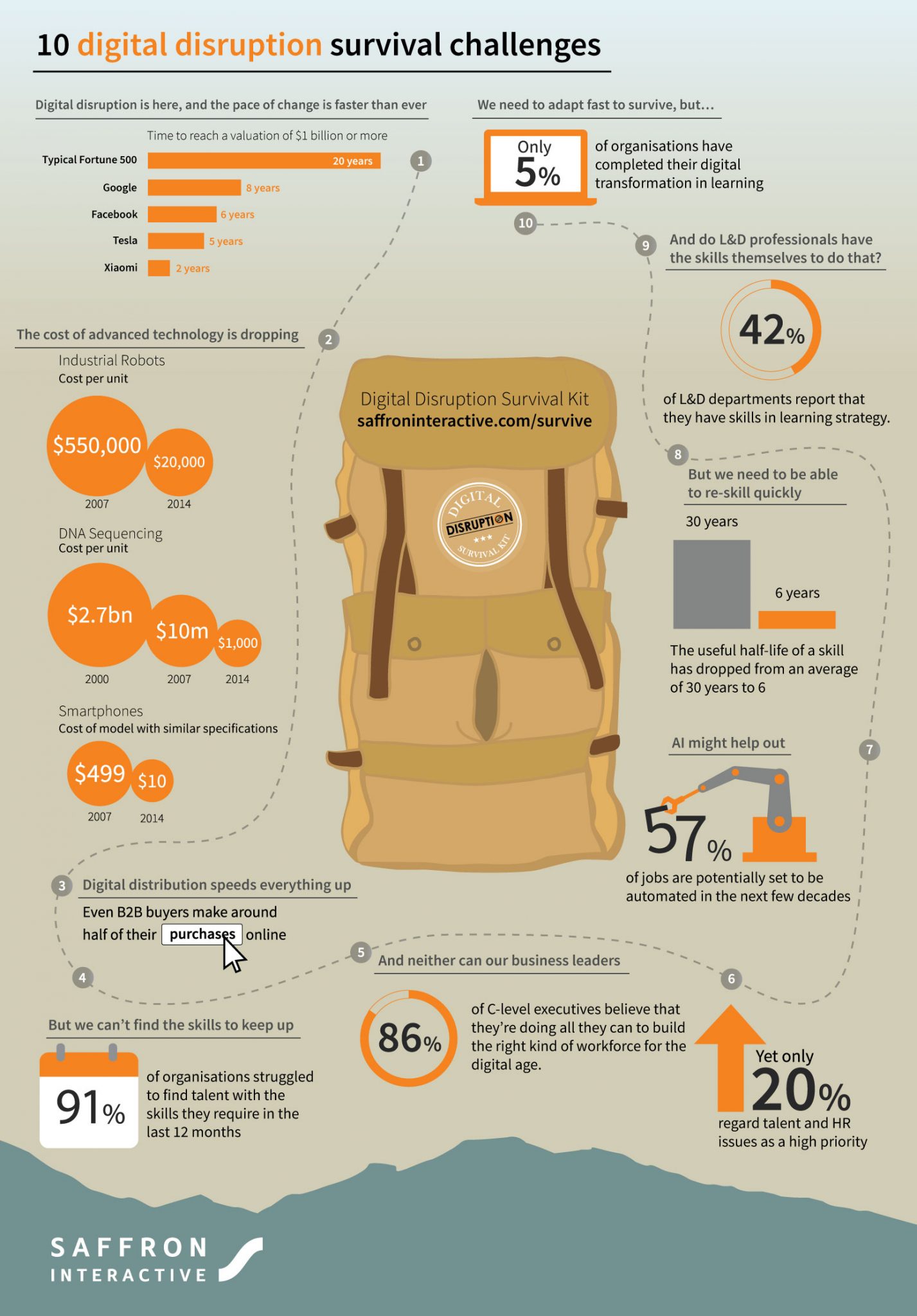
In the past year, 91% of organisations struggled to find talent with the skills they require. At this year’s Learning Technologies Conference and Exhibition, Saffron Interactive will showcase the strategy and technology needed to overcome that. Transferable and new skills assessment, point-of-need virtual assistants and chatbots to build capability can be tried on Stand B50.


Not another ‘Learning Trends 2019’ list – here’s what we really need to do better this year
There’s been a deluge of prediction lists recently, as there always is at this time of the year. ‘Learning trends 2019’… ‘What’s hot in L&D this year?’… ’17 unbelievable learning predictions, number 8 will blow your socks off!’
It’s always the same. Take a moment to look back at a couple of last year’s lists. They look almost identical, just spun slightly differently by marketing teams (sorry) and influencers. Yes, that might just reflect the snail’s pace this industry can move at, but it’s also a sign that we’re looking in the wrong places.


Transforming Noëledge – a Christmas learning tale
“It was Boxing Day when I knew something had to change. There was no way we could continue as we were,” the elf said as she looked up from the mug of hot chocolate she cradled for warmth between her little hands. “We still love him of course, but he is so stuck in his ways. Something has to change.”


The benefits of using minimalism in digital learning
The term ‘minimalism’ emerged during the 1960s to describe a visual art style where the focus is on simplicity. In 1964, minimal artist Frank Stella coined the iconic phrase “what you see is what you see” when describing how to interpret his work. Nowadays, the minimalist mantra is upheld in a variety of industries from architecture to design and even lifestyle. The notion remains the same in all of them. Keep it simple. We need to bring minimalism to digital learning.


10 key best practices for learning interaction design
The interaction design in your learning will make or break your learner’s user experience. Content is key, but the way that the learner is made to interact with that content in order to assimilate it and put themselves in the position of “learning by doing” is even more important.
The interaction design in your learning will make or break your learner’s user experience. Content is key, but the way that the learner is made to interact with that content in order to assimilate it and put themselves in the position of “learning by doing” is even more important.
The interaction design in your learning will make or break your learner’s user experience. Content is key, but the way that the learner is made to interact with that content in order to assimilate it and put themselves in the position of “learning by doing” is even more important.
The interaction design in your learning will make or break your learner’s user experience. Content is key, but the way that the learner is made to interact with that content in order to assimilate it and put themselves in the position of “learning by doing” is even more important.
The interaction design in your learning will make or break your learner’s user experience. Content is key, but the way that the learner is made to interact with that content in order to assimilate it and put themselves in the position of “learning by doing” is even more important.